
No slideshow available
 The House of Albenga
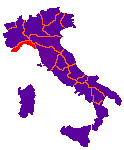
Italy, Region of Liguria, approximately 90 km au south-west of Genoa, city of Albenga.
No slideshow available
The House of AlbengaItaly, Region of Liguria, approximately 90 km au south-west of Genoa, city of Albenga.
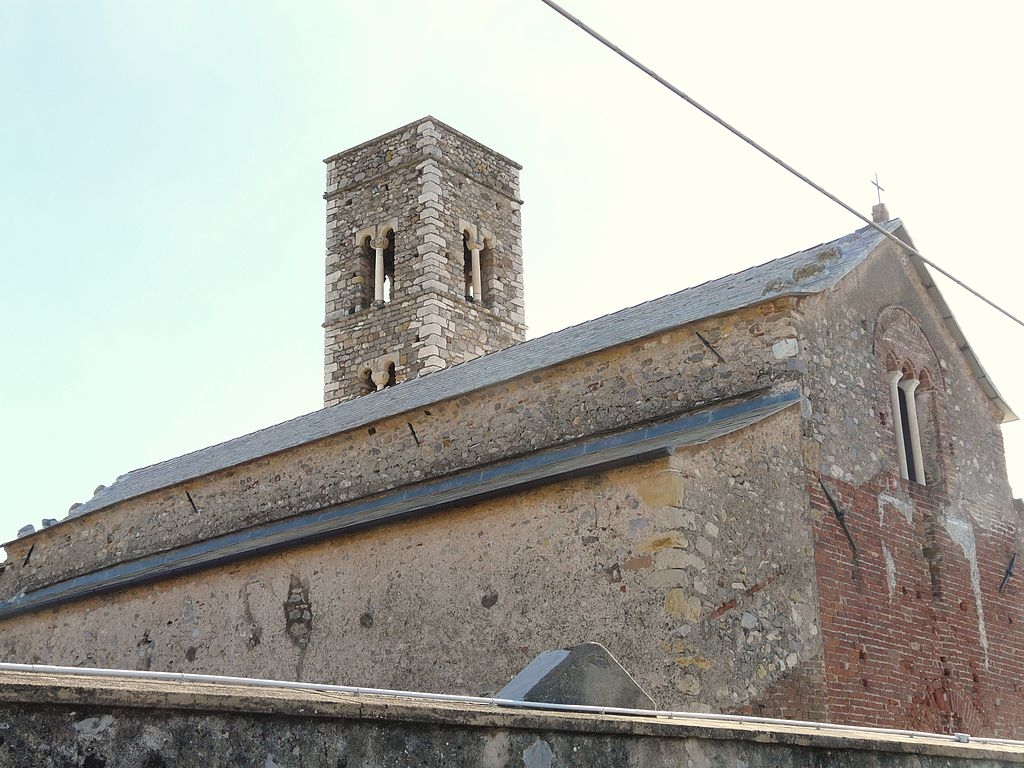
The exact date of the Templars' arrival in Albenga is unknown, but a document dated April 1143 mentions that a certain Oddone de Legen(1) and his daughter Lombarda sold a plot of land in Albenga, near the church of San Calocero de Campora, to Oberto, a Brother of the Temple. This land adjoined an estate that already belonged to the Temple and another estate belonging to the Hospitallers. In October of the same year, the same Oddone de Legen and his daughter Lombarda sold another estate, located "next to" the first, to the same Oberto.
In the following years, the Knights Templar continued to expand their domain by continuing to purchase and/or receive land that was more or less contiguous to it. Thus, in 1144, it was still Oberto who received numerous donations, while in 1145, two new Brothers of the Temple (two "true" brothers?) Ugo and Guglielmo Normanno received them.
In 1167, a document mentions one of the rare examples of affiliation to the Order by a secular couple, namely a certain Robaldo Marabotto and his wife Giusta, who devoted themselves to the church of San Calocero del Tempio, for the honour of God and service to the Temple of Jerusalem as "donats". By giving themselves to the Order as individuals, they also donated an estate located in a place called Becelega, as well as all their property in Valirano, two hamlets located near Albenga and a plot of land adjacent to its walls. Following this donation, Brother Bonifacio, Master of the Temple in Italy, ordered that the church of San Calocero, along with all its movable and immovable property, present and future, located in the Albenga area, be placed at the disposal of Robaldo Marabotto, who would be required to pay an annual rent.
This donation as "persons" seems significant in several respects, as it is the only affiliation document that has been found in north-western Italy. First of all, Robaldo and Giusta are the only married affiliates recorded in this region, and moreover they were accepted by the Master of Italy himself. It is impossible to verify the reasons for this acceptance by a dignitary of such high rank. Was it due to the size of the land donation associated with it? This is a question that will probably never be answered.
It is nevertheless interesting to note that the management of the entire estate of the house of San Calocero was entrusted to this Robaldo, in exchange for which he paid an annual rent. It is not known why the Order wanted the house to be administered by a "donat", unless the decision to make it a leased estate was taken as soon as he arrived.
In 1181, documents mention the names of two other administrators of San Calocero, a certain Guglielmo di Vignano and a certain Guido, who acted on behalf of the Order to acquire an estate from a woman named Donata, daughter of the late Graselveto. It is interesting to note that one of the witnesses to this deed was Oddone Marabotto, probably a relative of Robaldo. Over the following months, Guglielmo di Vignano continued to carry out transactions on behalf of the Temple, and Oddone Marabotto was frequently mentioned as a witness in the deeds.
Despite the fact that the house of San Calocero d'Albenga seemed to be growing and prospering, in January 1191, the Master of Italy, Brother Gaimardi, ceded the entire estate to the Bishop of Albenga in exchange for an annual rent. The reasons for this transfer are debated among historians, but the consensus seems to be that at that time, the Order was greatly weakened after the defeat of the Christian armies at Hattin in 1187 and the subsequent capture of Jerusalem. In addition, the siege of Saint-Jean d'Acre, which began in the summer of 1189, was also extremely costly for the entire Christian world.
It would appear that the Bishop of Albenga did not fully comply with the terms of the contract, and in 1224, a dispute arose between the Order and the bishop. The dispute caused such a stir in ecclesiastical circles that Pope Honorius III had to appoint a committee composed of the Bishop of Tortona(2), the Bishop of Savona(3) and the Abbot of Santo Stefano in Genoa(4) as arbitrator in the conflict. In the end, the arbitration was decided in favour of the Order, and the bishop was obliged to pay the arrears of unpaid rents as well as an additional sum in compensation to the Order.
After a final document dated 1267, which concerns the same issue of non-payment of rent by the bishopric to the Order and which ended in an amicable agreement, nothing is known about what became of this house in San Calocero once it passed into the hands of the Hospitallers of St John, nor why it disappeared completely.

(1)Little is known about the life of Oddone de Legen (also known as Odon de Légen). He is mainly mentioned in texts from the period when he was preceptor of Lombardy, between 1180 and 1190. It is possible that his donation of his estate in Albenga was linked to his entry into the Order..
(2)This is probably Pietro Quarti, Bishop of Tortona from 1221 to 1240. He came from a noble family in the region. He was elected to the episcopal throne a few months after the death of his predecessor, Pietro Bussequi, in 1220. His episcopate was marked by the struggle between the German Emperor Frederick II of Hohenstaufen and the papacy. Pietro Quarti also had to fight against the rise of the Commune of Tortona, which wanted to abolish many of the bishop's prerogatives. He also encouraged the establishment of the Mendicant Orders, Dominicans and Franciscans, in his domain. He died unexpectedly in 1240.
(3)This is probably Alberto Calvi da Cilavegna, also known as Albeto de Novara. He was born around 1170 - 1180 in Cilavegna, a town south-west of Milan. An expert in canon law, he quickly became part of Pope Honorius III's inner circle. He was appointed bishop of Savona around 1221 until his "resignation" in 1227, when he retired as a canon in Novara, where he died in 1230.
(4)This is probably Guglielmo, who was abbot of Santo Stefano in Genoa between 1221 and 1229. He was likely from a family of minor Ligurian nobility. Under his leadership, the abbey reached the height of its land ownership.

Templiers.org - Christophe Staf
All Rights Reserved
Member of the Templars Heritage Route - Route du Patrimoine Templier