
No slideshow available
 The Castle of Algars
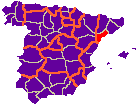
Spain, province of Tarragona, around 100 km west of Tarragona, municipality of Batea.
No slideshow available
The Castle of AlgarsSpain, province of Tarragona, around 100 km west of Tarragona, municipality of Batea.
The arrival of the Knights Templar in this region on the borders of the modern provinces of Catalonia and Aragon was due to the significant donation(1) made in 1153 to the Order by the Count of Barcelona and Prince of Aragon, Ramon Berenguer IV(2), after his conquest of numerous strongholds in the Ebro Valley, including Tortosa and Miravet.
The repopulation of these territories, which was the responsibility of the Order under the terms of the "Miravet" donation, was significantly delayed. In 1181, King Alfonso II of Aragon decided to cede the region of Algars and its castle to Aragonese knights and settlers. The Order protested this decision on the grounds of its rights over these territories, and, unable to resist the arguments and appeals put forward by the Templars, Alfonso II confirmed their rights and returned the region of Algars to their authority the following year, in 1182.
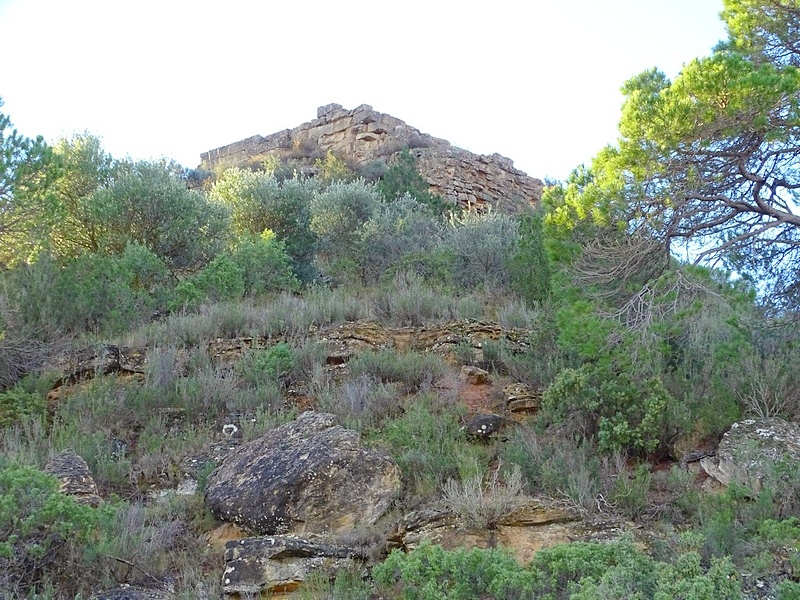
It would appear that it was from this point onwards that Algars really began to develop. However, this initial momentum was soon halted due to a severe shortage of settlers and labour available to the Order. And so, in 1216, despite the Order having published a charter of franchise and settlement a few years earlier, a knight named Artal d'Artusella(3) seized the Algars estate. Once again, the Order had to appeal to the royal court before the king, Jayme I, ruled in its favour and forced Artal d'Artusella to return the estate.
It was only then that the Order finally installed a commander in Algars Castle. A document dated 1227 gives us the name of the commander of Algars: Pons d'Inlice, mentioned in a deed of purchase for a mill in the hamlet of Corbera, located about fifteen kilometres away.
After the dissolution of the Order of the Temple in 1312, the entire Algars estate was transferred to a knight from the town of Batea. The estate survived as best it could over the centuries, but in the 18th century, a document indicates that the castle was nothing more than ruins with a few walls still standing.
The Algars estate consisted of several outbuildings. In addition to the San Joan chapel at the foot of the castle and a fortified farmhouse called Mas de Roda, the Order also owned a small village, now abandoned, located a little further north called Pinyères. A little further south, the Knights Templar seem to have built a fortification from scratch in the hamlet of Almudèfer, which is now part of the municipality of Caseres.
(1)In 1153, after conquering numerous important cities and fortresses south of his domains, Ramon Berenguer IV of Barcelona had to ensure not only their defence, but also their repopulation by Christians. He therefore entrusted the Knights Templar with these two missions in a large part of these regions. This mission was sealed in one of the most important donations that the Knights Templar would ever receive, namely the donation of Miravet Castle and numerous other estates located along the Ebro Valley. The Order of the Temple was then put in charge of the security of this entire area against incursions by the Almohads. This donation was undoubtedly also compensation for the "Testament of Alfonso I "the Battler", who had bequeathed his kingdom to the Orders of the Temple, the Hospital and the Holy Sepulchre in 1134. This bequest was rejected by the Aragonese nobility, who had propelled Ramon Berenguer IV to the throne. With this donation, known as the "Miravet", the count obtained the assurance that the Order of the Temple would officially and definitively renounce all claims to the crown of Aragon.
(2)Raimond-Bérenger (Ramon-Berenguer) IV of Barcelona, known as "the Saint". He was born in Barcelona in 1113 and died in Borgo San Dalmazzo, Italy, in 1162. He was Count of Barcelona, Girona, Cerdanya and Osona, Ribagorce and Prince of Aragon. He was the son of Raimond-Bérenger III, Count of Barcelona, and Dolça, daughter of Gilbert I, Viscount of Gévaudan, and Gerberge d'Arles, Countess of Provence. He inherited his various counties upon his father's death in 1131. In 1137, he signed a marriage agreement with Ramire II, King of Aragon, who promised the hand of Petronilla (born the previous year) to the Count of Barcelona as soon as she reached the legal age of 14. The marriage took place in 1150. The signing of this agreement allowed him to unite his own domains with those of the Crown of Aragon and to bear the titles of Prince of Aragon and Count of Ribagorza. Taking advantage of the weakening of the Almoravids, he conquered several large cities in the south of his territory, including Almería, Tortosa and Lleida. His reign was also affected by the war he waged against his Christian neighbours to the north, the Counts of Toulouse and Provence, in what history calls "The Great Southern War". While crossing the Alps to meet Emperor Frederick I "Barbarossa" in Turin, he fell ill and died in early August 1162.
(3)Artal d'Artusella or Artal de Artusela was a knight from the minor nobility of Aragon, often referred to as "Mesnaderos" or "Infanzones". Virtually nothing is known about his origins or his life. The archives only mention him in connection with the conflict with the Knights Templar after he took their domain of Algars in 1216.


Templiers.org - Christophe Staf
All Rights Reserved
Member of the Templars Heritage Route - Route du Patrimoine Templier