
No slideshow available
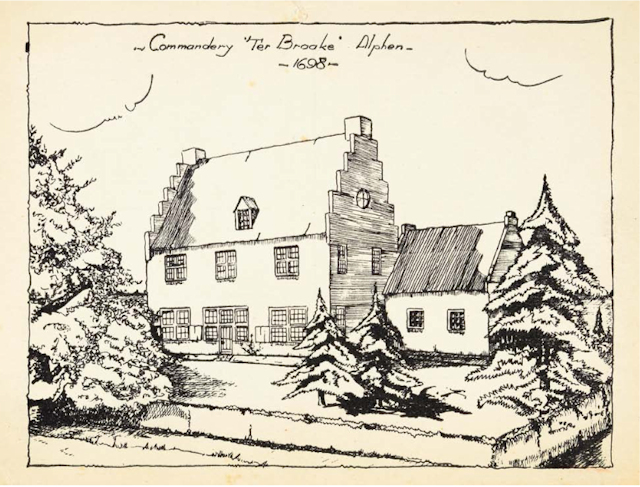
 The House of Ter Brake (Alphen)
Contributor: Jean Roefstra
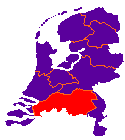
Netherlands, Province of North Brabant, approximately 20 kilometres south-east of Breda, village of Alphen.
No slideshow available
The House of Ter Brake (Alphen)Contributor: Jean Roefstra
Netherlands, Province of North Brabant, approximately 20 kilometres south-east of Breda, village of Alphen.
The earliest known mention of the existence of a Templar house in Alphen is found in a document dated 1187(1) in which a certain Gérard de Duffel gives the brothers of the Order of the Temple his allodial estate in Alphen, on condition that the Order pays him an annual rent of three marks.
As this is the earliest reference to Alphen, historians debate whether it refers to the founding of the preceptory or whether it already existed before that.
Some even estimate its foundation to be around 1140 - 1150, thanks to the generosity of the lords of Breda. It would also appear that the monks of Tongerloo Abbey had an influence on the establishment of the Knights Templar in Alphen.
In 1212 and 1214, Henry I, Duke of Brabant(2), confirmed several donations made to the Order, including one made by Alveric of Turnhout of a farm and one made by Count William of Megen(3) and his son Thierry of the allodial estate of Rixtel and all its dependencies.
In 1236, the templar house of La Bracque was the subject of a compromise, the origin of which is unclear, between Pons d'Albon, Master of the Temple in France, and Brother Jean, abbot of Tongerloo. At that time, the commander of La Braque was a certain Brother Hermann.
Other charters concerning the preceptory of La Braque are kept in the French National Archives in Paris, but in general they tell us very little about the preceptory. Nevertheless, one of the last ones, dated 1289, mentions that the house of La Braque ceased to be the seat of a Templar preceptory, as it was then leased out with all its outbuildings.
In 1313, after the transfer of the Templars' property to the Order of St John, the inventory drawn up by the new owners indicates that the estate was underdeveloped and in fairly poor condition.
At the height of its development, the commandery of La Braque owned, in addition to land in Alphen, a mill in the same town, another in Oosterhout, an outbuilding in Rixtel and another in Turnhout, and also collected several taxes and tithes.

(1)Preserved at the National Archives of France - box S. 5255.
(2)Born around 1165, died in Cologne on 5 September 1235, Duke of Brabant from 1183 to 1235, Count of Leuven, Marquis of Antwerp and Duke of Lower Lorraine from 1190 to 1235. He was the son of Godfrey III, Count of Leuven, Landgrave of Brabant, Marquis of Antwerp and Duke of Lower Lorraine, and Margaret of Limburg.
(3)Megen is currently a small town in the Netherlands located in the north of the province of North Brabant along the Meuse River. The county of Megen is mentioned in texts dating back to 1145.

Templiers.org - Christophe Staf
All Rights Reserved
Member of the Templars Heritage Route - Route du Patrimoine Templier