
No slideshow available
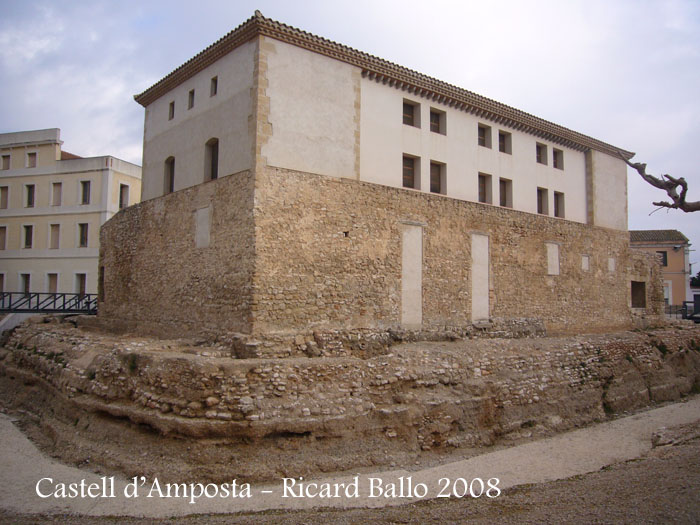
 The Castle of Amposta
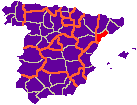
Spain, province of Tarragona, approximately 80 km south of Tarragona, town of Amposta.
No slideshow available
The Castle of AmpostaSpain, province of Tarragona, approximately 80 km south of Tarragona, town of Amposta.
In 1150, Ramon Berenguer IV(1) ceded the castle and territory of Amposta to the Order of the Hospital of St John. However, for this donation to take effect, the Knights Templar had to renounce the part of the territory that belonged to them by right of conquest, which they did three years later, in 1153, when they took possession of Miravet. At the time this agreement was signed, the Hospitallers had already established a convent in Amposta.
The document relating to the donation of Amposta mentioned a sum of money intended to cover the cost of converting the castle into a residence for the Hospitallers. This donation, together with the Order's installation in the castle and the arrival of settlers to occupy the land, would become the nucleus of the future town of Amposta, an important strategic location in the defence of Tortosa.
As soon as they settled there, the Hospitallers made Amposta an important administrative centre responsible for colonising, exploiting and administering the territories of the Ebro Delta and the area north of the Serra de Montsià.
With these rights in the Delta, in addition to fishing rights in the Tortosa area and the collection of tithes from the salt marshes granted to them by Count Ramon Berenguer IV, Amposa became one of the richest preceptories in the region.
The development of this significant economic influence is reflected in the fact that, as early as 1154, Amposta became the seat of the Catalan-Aragonese province of the Order of the Hospital. From then on, in addition to the commander of Amposta, the castle also housed the commander of the province, who bore the title of "Castellán d'Amposta".
As part of the defensive strategy for the mouth of the Ebro River, several towers performed military functions that complemented those of Amposta Castle. This was the case, among others, with two towers that were the subject of a dispute between the Knights Templar and the Knights Hospitaller, until in 1189 Alfonso II "the Chaste" demanded that the Knights Hospitaller prove that they belonged to them. These were probably towers located on the right bank of the Ebro, and one of them may even have been the tower of Carrova(2), as the same conflict also concerned the use of water from the Carrova spring.
The advance of the Reconquista towards the south led to the decline of Amposta as a strategic site. Thus, around 1280, King Peter III "the Great" undertook to recover the estates that his predecessors had bequeathed to the Order of the Hospital. At that time, the Hospitallers exchanged their estate in Amposta with the King for estates further south, near Valencia. However, the Hospitallers retained several properties in Amposta, including the castle, which had lost its military function, and the parish church.
(1)Raimond-Bérenger (Ramon-Berenguer) IV of Barcelona, known as "the Saint". He was born in Barcelona in 1113 and died in Borgo San Dalmazzo, Italy, in 1162. He was Count of Barcelona, Girona, Cerdanya and Osona, Ribagorce and Prince of Aragon. He was the son of Raimond-Bérenger III, Count of Barcelona, and Dolça, daughter of Gilbert I, Viscount of Gévaudan, and Gerberge d'Arles, Countess of Provence. He inherited his various counties upon his father's death in 1131. In 1137, he signed a marriage agreement with Ramire II, King of Aragon, who promised the hand of Petronilla (born the previous year) to the Count of Barcelona as soon as she reached the legal age of 14. The marriage took place in 1150. The signing of this agreement allowed him to unite his own domains with those of the Crown of Aragon and to bear the titles of Prince of Aragon and Count of Ribagorza. Taking advantage of the weakening of the Almoravids, he conquered several large cities in the south of his territory, including Almería, Tortosa and Lleida. His reign was also affected by the war he waged against his Christian neighbours to the north, the Counts of Toulouse and Provence, in what history calls "The Great Southern War". While crossing the Alps to meet Emperor Frederick I "Barbarossa" in Turin, he fell ill and died in early August 1162.
(2)The Tower of Carrova is located approximately 4 km north of Amposta, on the right bank of the Ebro River.

Templiers.org - Christophe Staf
All Rights Reserved
Member of the Templars Heritage Route - Route du Patrimoine Templier