
No slideshow available
 The House of Andria
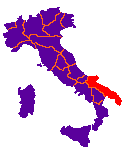
Italy, Apulia region, around 55 km north-west of Bari, town of Andria.
No slideshow available
The House of AndriaItaly, Apulia region, around 55 km north-west of Bari, town of Andria.
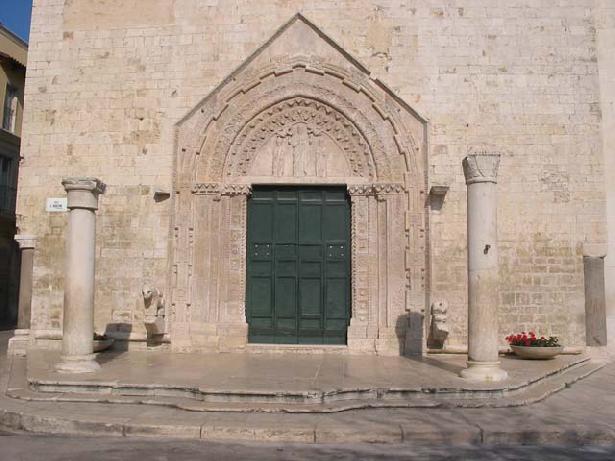
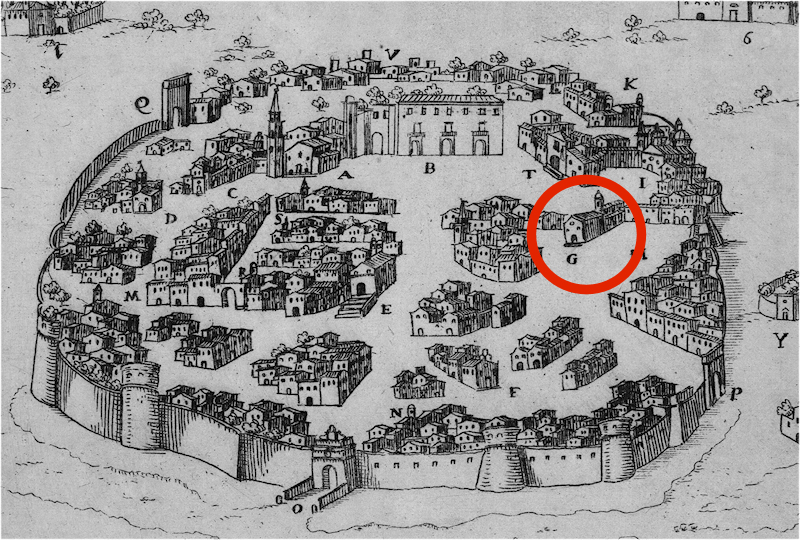
Although it is not explicitly mentioned, the oldest document relating to the Templar House of Andria probably dates from 1196, when Pietro di San Gregorio is named as preceptor of the House of San Leonardo, a term associated with this preceptory. If this document does indeed refer to the Templar House of Andria, it means that the Order was established there a few years earlier, probably before the 1190s.
The Templar Order did not keep this house for long, because in 1228 - 1229, the German Emperor Frederick II of Hohenstaufen, embroiled in his conflict with the Church and the Papacy, seized all the property of the Order, an unwavering supporter of the Pope, in the Kingdom of Sicily and transferred it to the Teutonic Order.
For reasons unknown, the Teutonic Order, undoubtedly under pressure from the Duke of Andria(1) Francesco del Balzo(2), ceded the commandery to the Order of Saint Augustine(3), which retained it until 1809. The commandery church is the only remaining vestige of the complex and still bears the name of Saint Augustine.

(1)The Duchy of Andria is the heir to the Norman County of Andria, established in the 11th century during the Norman invasion of Sicily and southern Italy. In 1266, when Charles I of Anjou became King of Sicily, the county was incorporated into the royal domain. In 1309, when Beatrice of Anjou, daughter of KingCharles II, married Bertrand III des Baux, she brought the domain of Andria with her as part of her dowry. It was under François des Baux (Francesco del Balzo), son of Bertrand III, that the domain of Andria was elevated to a duchy, probably in 1351.
(2)François des Baux or Francesco del Balzo was born in 1330 and died in 1422. He was the son of Bertrand III des Baux, Count of Andria, and his second wife, Marguerite d'Aulnay, daughter of Robert d'Aulnay de Teano and Isabelle de l'Estendart. Upon his father's death in 1351, he became the first Duke of Andria. He was the father of Jacques des Baux, the last Latin Emperor of Constantinople.
(3)The Order of Saint Augustine (Ordo Fratrum Sancti Augustini), also known as the Order of Hermits of Saint Augustine (Ordo Fratrum Eremitarum Sancti Augustini), is a mendicant order founded by four anchorite hermits in 1243 with the blessing of Pope Innocent IV. The Pope thus founded a third mendicant order, after the Franciscans (in 1209) and the Dominicans (in 1215).

Templiers.org - Christophe Staf
All Rights Reserved
Member of the Templars Heritage Route - Route du Patrimoine Templier