
No slideshow available

 The House of Les Andrivaux
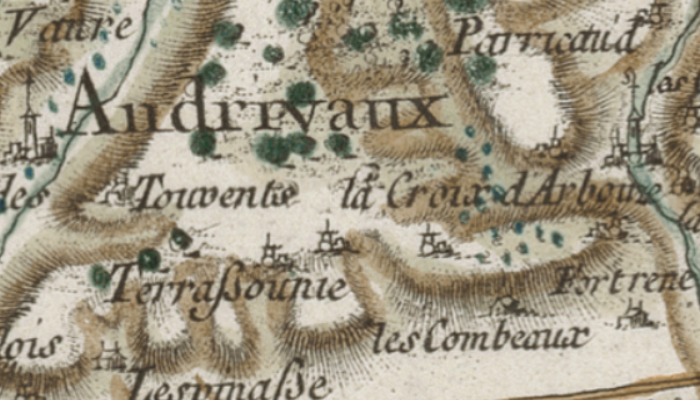
France, department of Dordogne, around 70 km south-east of Angoulême, municipality of Chancelade, hamlet of Les Andrivaux.
No slideshow available
The House of Les AndrivauxFrance, department of Dordogne, around 70 km south-east of Angoulême, municipality of Chancelade, hamlet of Les Andrivaux.
The Andrivaux estate was probably occupied by a small community of Benedictine nuns since the 10th century. This community occupied the premises for nearly two centuries, but was in inevitable decline.
It is not known exactly why the nuns were forced to abandon the estate, but in 1139, the Bishop of Périgueux, Geoffroy I de Cauze(1), gave the entire parish of Les Andrivaux to the Order of the Temple, along with the former Benedictine convent, where the Order established its preceptory headquarters.
Shortly after this donation, the archives only record a few minor donations in the 12th century. The most significant donations, at least those preserved in the archives, appear to have been made in the first half of the 13th century, with a major donation in 1228 by the knight Bertrand de Joffre (or de Geoffroy) and his brother Guillaume of all their rights to the Chambon mill(2). This donation was made in the presence of the Count of Périgord Archambaud II(3), Hélie de la Barthe, preceptor of the Order in Périgord, and Guillaume de "Traulega", commander of the Andrivaux.
In 1240, a major dispute between the Order, represented by the Master of Périgord, a certain Raymond Ayz, and the knight Ebblon II de Saint-Astier, Lord of Montanceix(4), was resolved in favour of the Order. This dispute originated from a donation made in the mid-12th century by Izarn de Saint-Astier, his grandfather, who had ceded his entire seigneury of Les Andrivaux to the Order, supplemented by that made by Bertrand, his son, of all rights of use, grazing(5) and fishing on all his lands. Ebblon contested the rights of the Commander of Les Andrivaux in the forest of "Lancinade". The arbitration carried out by Count Hélie de Périgord(6) resulted in a compromise in favour of the Order, in that the Commander of Les Andrivaux could take all the wood he needed, provided he notified the Lord of Montanceix in advance. Ebblon, submitting to the arbitration ruling, made a gesture of reconciliation with the Order by officially confirming all previous donations made by his ancestors. As a token of definitive reconciliation, the Commander of Périgord gave Ebblon the sum of 12 pounds.
In 1252, the same lord Ebblon de Saint-Astier is witness of the donation made by the six children of Pierre de Saissac of all the fiefdoms located in the parish of La Capela d'Agonaguet (now the commune of La Chapelle-Gonaguet) to repair the damage their father had done to the Order. They also promised never to denounce this donation before the courts. In recognition, the Commander of Les Andrivaux paid the siblings the sum of 33 livres and solemnly "forgave" their father's soul for all the wrongs caused to the House of the Temple. This donation enabled the creation, thanks to the arrival of new "settlers", of the village of Chantegéline (now Chantepoule in the commune of Mensignac).
Subsequently, the commandery continued to receive smaller donations until the fateful date of the arrest of the Knights Templar in 1307. Among these donations was one made in 1276 by the knight Gérard de Chabans of his estate of "Pressegarots"(?) – also sometimes spelled "Preissegier" – located in the commune of Mensignac, before joining the Order with his son in 1286, having presumably become a widower in the meantime.
In 1312, after inheriting the Andrivaux estate, the Order of Saint John continued to develop it by adding several of their estates located on the right bank of the Isle river. Around 1440–1450, the Andrivaux commandery was attached to that of Condat-sur-Vézère.
Virtually nothing remains of the buildings of the Templar commandery, except for a few ruins that have been incorporated into more recent buildings.

(1)Geoffroy I of Cauze, also referred to in charters as Geoffroy de Courtille or Geoffroy de Corton. He was elected Bishop of Périgueux in 1138 to succeed Guillaume III of Nanclars. His tenure as bishop was short-lived, as he died in 1142.
(2)This estate was located in a bend of the Isle river, two kilometres south of Les Andrivaux as the crow flies, in what is now the municipality of Marsac-sur-l'Isle.
(3)Archambaud II was Count of Périgord from 1209 (some sources mention 1210 or even 1212) to 1239. He was the son of Count Hélie V and Marguerite de Limoges, daughter of Viscount Adhémar V of Limoges and Sarah of Cornwall. He was born around 1170(?) and died in 1243. He became Count of Périgord between 1209 and 1212 upon the death of his father. He married Guilhelme (or Wilhelmine) de Gourdon, daughter of a certain Fortanier, Lord of Gourdon. He abdicated in favour of his eldest son Hélie VI in 1239 to make a trip to the Holy Land, undoubtedly as part of what history has recorded as the French Crusade. He died there in 1243.
(4)Ebblon (or Ebles) II of Saint-Astier came from one of the younger branches of an important Périgord family. He was Lord of Montanceix (now the commune of Montanceix), a stronghold located about ten kilometres south-west of Les Andrivaux, on a rocky spur overlooking the Isle. He was born in the last decades of the 12th century and probably died around 1250 - 1255. His father was probably Geoffroy de Saint-Astier, who passed on the lordship to him upon his death.
(5)In the Middle Ages, the right of grazing or common grazing allowed the holder to graze their livestock outside their own land, on fallow plots or after harvest, and also on the sides of roads and paths.
(6)Hélie VI (sometimes numbered Hélie VIII) was Count of Périgord from 1239 to 1251. He was born around 1210 and died in 1251. He became Count of Périgord in 1239 when his father abdicated in his favour before embarking for the Holy Land to take part in the French Crusade. He died in 1251 of unknown causes.

Templiers.org - Christophe Staf
All Rights Reserved
Member of the Templars Heritage Route - Route du Patrimoine Templier