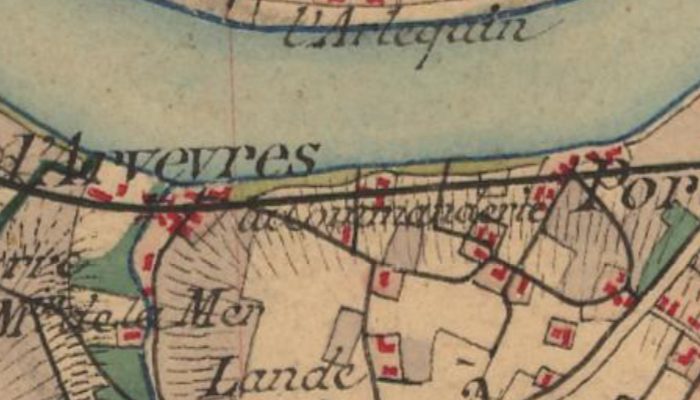
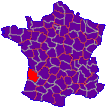
France, department of Gironde (33), approximately 25 km east of Bordeaux and 5 km south-west of Libourne, commune of Arveyres.
According to studies by Baron de Marquessac and Jean-André Garde, the origins of the Commandery of Arveyres date back to 1170, when Bertrand de Montauld, Archbishop of Bordeaux(1), granted the Order of the Temple the church of Saint-Pierre des Vaux along with almost all its outbuildings. Subsequently, in the year 1231, the Lord of Vayres(2) ceded to them the territory of Arveyres, which was situated within his castle district.
Following these donations, the Knights Templar decided to establish their house on a hillock on the left bank of the Dordogne, between the ports of Arveyres and Laroque.
The lords of Vayres also entered into an agreement whereby the Knights Templar retained jurisdiction over Arveyres, secured the transfer of the Bois de Tillhède, and were granted the right to ship their goods from the two neighbouring ports without paying duties.
It was following this agreement, reached in 1264, that the four crosses of Arveyres were erected to mark the boundaries of the Preceptory’s jurisdiction.
It was no doubt the strategic importance of the site that led the Knights Templar to establish a commandery on this estate. Indeed, it is situated at the junction of the road from Périgueux to Bordeaux and on to Spain, close to a crossing point over the Dordogne.
The purpose of the Commandery of Arveyres was to establish a land-owning seigneury capable of generating revenue to finance expeditions to the Holy Land. The commandery’s land and property holdings were numerous and spread across several parishes, but were also supplemented by revenues derived from judicial privileges established within a "Sauveté"(3) bounded by the four crosses erected around the estate of the Commandery. Taken together, these assets conferred upon the Commandery of Arveyres a leading position amongst the military commanderies of the Bordeaux region.
These four crosses, made of wood or stone, have been restored or replaced on several occasions. The Fonsegrède cross, made entirely of stone, is the last cross marking the boundary of the Templars’ estate – a sort of quadrilateral representing the area over which the Order exercised its lordship. It is situated near the Church of Notre-Dame-d’Arveyres.
The Siston cross stands at a crossroads, in the hamlet of Siston, directly opposite the vicarage – probably a 17th century presbytery – which still retains a turret and a stone window adorned with stained-glass panes. The pedestal of this cross consists of a step upon which rests a first block of stone, followed by a second, more massive block, which supports the wrought-iron cross.
The Barre Cross, also made of wrought iron, stands on a small hillock by the roadside linking Vayres to Arveyres. Its base consists of a large, plain square stone, without ornamentation, into which a second stone is set, decorated with mouldings and a garland of roses.
The Royne cross stood on the plateau at a place known as Royne; both the cross and its base were made entirely of stone. This cross has now disappeared.
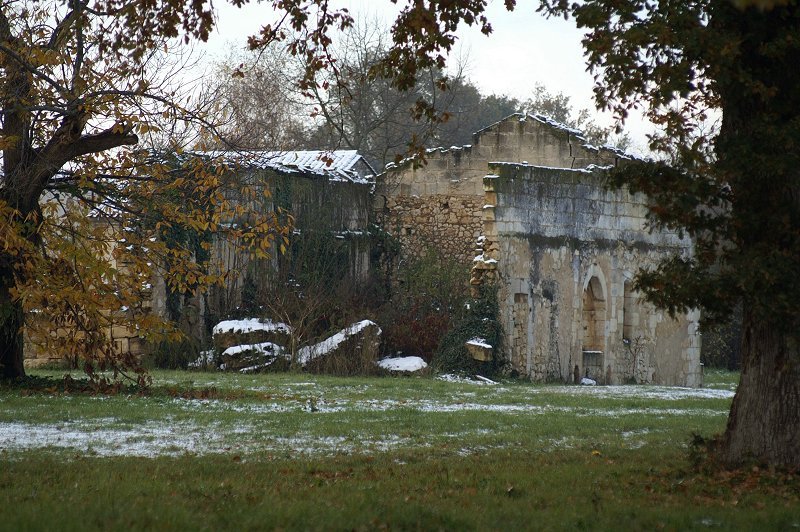
The Commandery originally comprised several buildings, including a large single-storey hall flanked by a tower and outbuildings. Today, the main building, which probably dates from the late 15th or early 16th century, houses the remains of a fireplace bearing the coat of arms of the Order of Malta. At present, only the ruins of the tower and a few outbuildings remain, including a kitchen with its fireplace and the opening of an oven.
In 2002, the archaeologist Jean-Luc Piat noted: "Several Gallo-Roman artefacts and structures have been discovered in a large number of test pits, and these previously unrecorded finds highlight the archaeological significance of the Commanderie site. Furthermore, the presence of a grave beneath a cover of rimmed tiles suggests the possible existence of a Gallo-Roman or early Christian necropolis in the vicinity of these ancient structures."
Today, Arveyres Town Council has purchased the property in order to breathe new life into this magnificent site, which had been neglected by the residents of Arveyres.
Following the deterioration of the buildings and the site’s use as an illegal rubbish dump, a charity was set up by residents of Arveyres to put a stop to this damage and restore the site to its rightful value. The various aims of this association, "Pour la Commanderie d’Arveyres", are to restore or even renovate the buildings, to use them for educational purposes and, if possible, to organise events.
The association’s contact details are available via this link : www.patrimoine33.com.
Notes :
(1)Bertrand de Montault, Archbishop of Bordeaux from 1162 to 1173.
(3)In medieval France, a "Sauveté" was a sanctuary marked out around a church or chapel by a number of "boundary markers". Within this area, the pursuit of fugitives was prohibited. These "Sauvetés" were most commonly found in the south and south-west of France.
 The House of Arveyres