
No slideshow available
 The Castle of Aizkraukles (Ascherade)
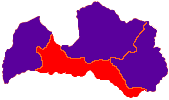
Latvia, Zemgale region, approximately 90 km south-east of Riga, Aizkraukles district, town of Aizkraukles.
No slideshow available
The Castle of Aizkraukles (Ascherade)Latvia, Zemgale region, approximately 90 km south-east of Riga, Aizkraukles district, town of Aizkraukles.
Since Ancient Times, the region of Aizkraukles, located along the Daugava River(1), has been a strategic location occupied by the Liv tribe(2) (also known as Livonians). Sources, mainly Scandinavian sagas, confirmed by archaeological research, mention the existence of a relatively imposing wooden fortification at this location since the 5th century AD.
This place changed hands several times between the "Vikings" and the Livonians, following conquests or changes in spheres of influence, until the end of the 10th century, when the Livonians regained complete control.
At the beginning of the 13th century, Germanic crusaders finally defeated the Livonian tribes and settled permanently in Aizkraukles. The Livonians' wooden castle, which had been severely damaged, was rebuilt into a proper fortified castle.
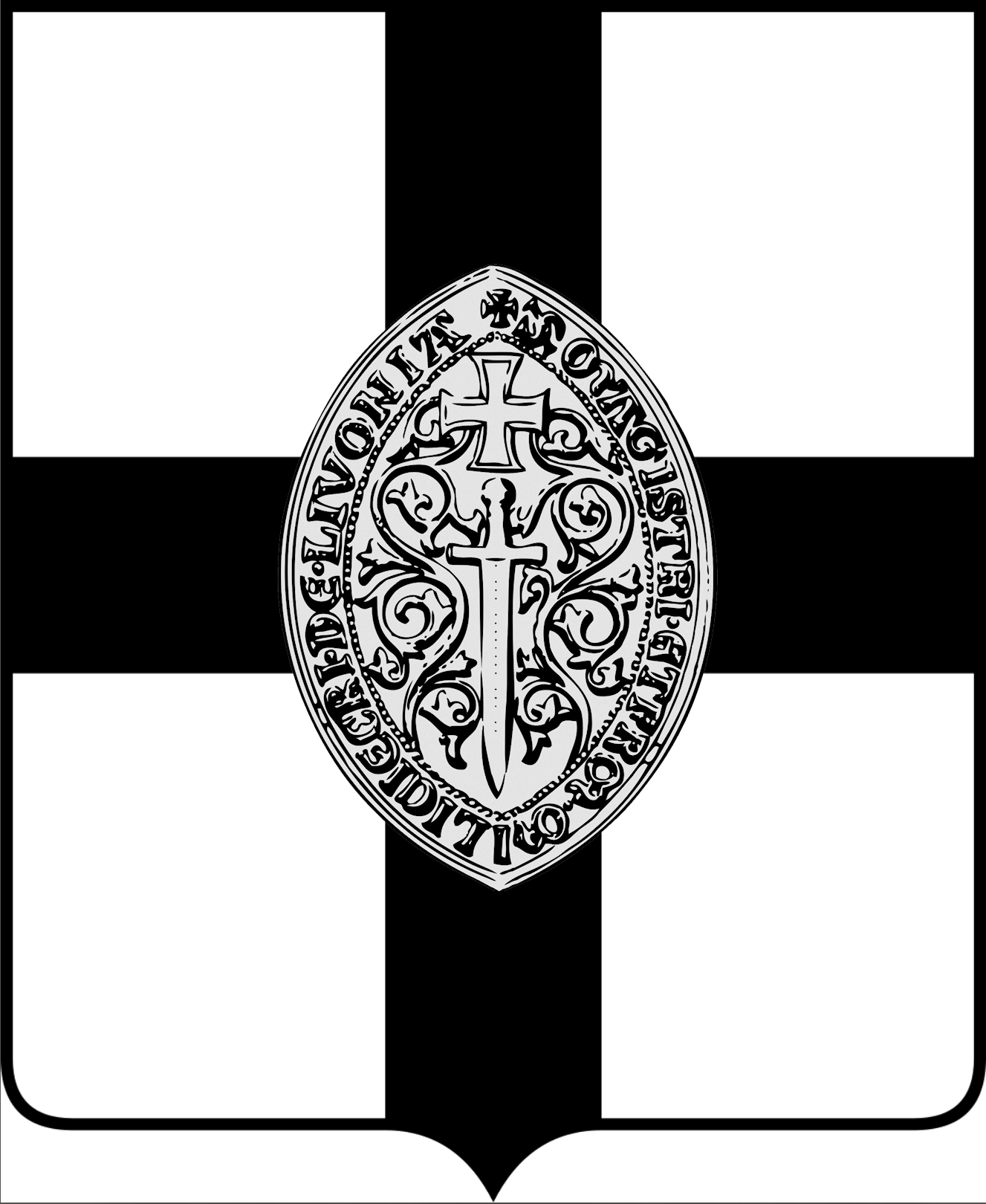
In 1211, the Bishop of Riga, Albert von Buxhoeveden(3), ceded the entire territory of Aizkraukles to the Order of the Livonian Brothers of the Sword, which he had founded a few years earlier.
The Order moved into the newly rebuilt castle and even established its headquarters there. But for reasons unknown, the Order decided to build a second fortress about 2 km from the first, on a peninsula at the confluence of the Daugava and Karikste rivers. The old castle would henceforth be known as Vecaizkraukles (Alt-Ascherade), while the new one would simply be called Ascheraden (Aizkraukles).
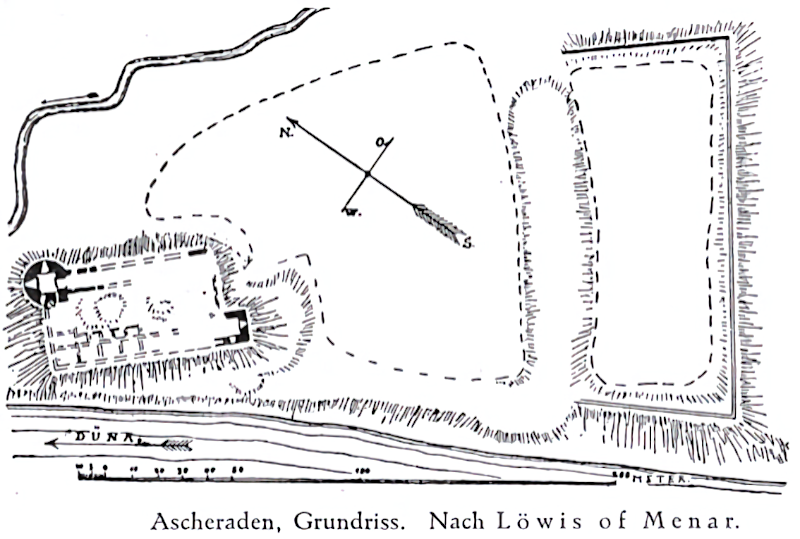
No historical documents have survived concerning the construction of this new castle. Archaeological research carried out at the site indicates that it was probably built between 1220 - 1230.
The castle was built on an almost square base measuring approximately 25 m by 30 m. It is protected by two wide moats that separate the castle itself from defensive fortifications located a little further away, forming what could be called two fortified "lower courtyards".
Located on the southern border of the already Christianised and Germanised territories, this new castle was attacked numerous times by the Zemgale, Livonian and Lithuanian armies, and was even partially destroyed on occasion.
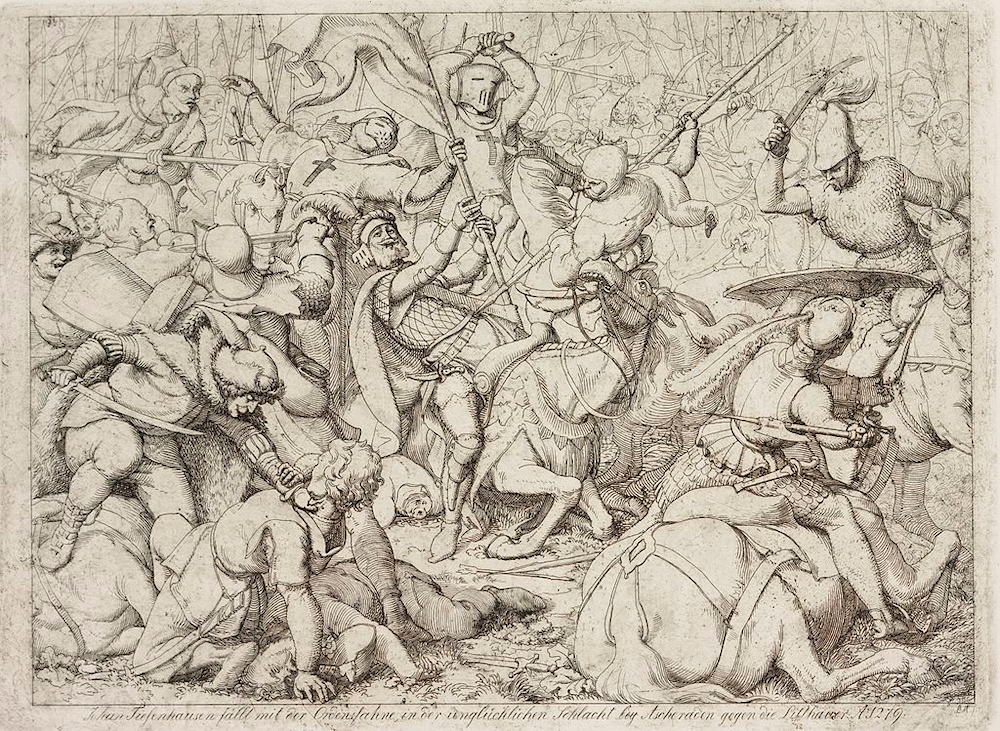
In 1279, Aizkraukles was the scene of a major battle between the Livonian Order and an army made up of Lithuanians and Zemgalians led by Traidenis(4), Grand Duke of Lithuania, and Namejs(5), Duke of Zemgale. The latter won a major victory and decimated the entire command staff of the Livonian Order, including its Grand Master, Ernst von Ratzeburg, and the Order's standard-bearer, Johann Tiesenhausen.
The castle continued to play an important role in protecting Christian territories against incessant incursions by the Zemgales, Livonians and Lithuanians for many decades.
In 1420, a document indicates that both castles in Aizkraukles were still in use and occupied by garrisons of the Livonian Order.
At the end of the 15th century, Aizkraukles Castle became one of the residences of the Land Marshal of the Order, i.e. the deputy to the Master of Livonia.
In the mid-16th century, Aizkraukles Castle found itself at the heart of the turmoil of what history has called the Livonian War(6). In 1561, the Order was dissolved and secularised after a major defeat in the early years of the war(7). The castle was then incorporated into the territory of the new Duchy of Livonia (8), which was a vassal state of the Grand Duchy of Lithuania.
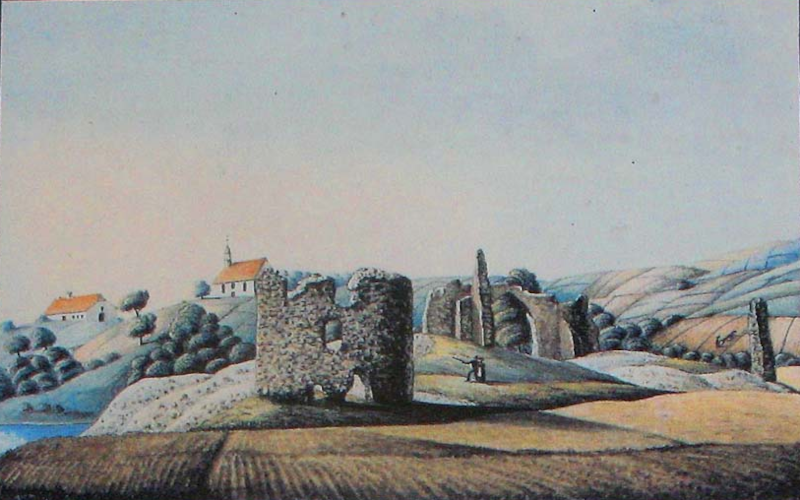
In 1599, an inspection revealed that the castle was badly damaged and could not be rebuilt. Its condition continued to deteriorate until it fell into ruin, which can still be seen today.
(1)The Daugava is a river in Europe that originates in Russia, near the small town of Andreapol, in the Valdai National Park, almost halfway between Moscow and Saint Petersburg. Over 1,000 km long, the river flows into the Baltic Sea in the Gulf of Riga.
(2)The Livs or Livonians are a Finno-Ugric people who settled around the Gulf of Riga, probably as early as a thousand years before Christ.
(3)Albert von Buxhoeveden was probably born around 1165 and died in Riga in January 1229. He came from a Saxon family of ministers from the village of Buxhoeveden (Bexhövede) in Lower Saxony. He was the son of Albert I of Buxhoeveden and Adelheid von Uthlede. Little is known about his early life, but he is mentioned as a canon in Bremen when his uncle, Hartwig von Uthlede, Prince-Elector and Archbishop of Bremen, appointed him Bishop of Livonia in 1199. He travelled to his new domain in the spring of 1200. In 1201, he began building a city on the site of a Livonian settlement at the confluence of the small Ridzene River and the Daugava River. This settlement would henceforth be called Riga. In 1202, with the Pope's consent, he founded the Order of the Brothers of the Sword of Riga. Around 1215, he declared his bishopric independent from that of Bremen. He died in 1229.
(4)Traidenis was probably born around 1220. He died in the spring of 1282. Virtually nothing is known about his origins or his family, except that he had a daughter, Gaudemunda, whom he married to the Duke of Mazovia, Bolesław II, around 1279. All that is known is that he belonged to a powerful Lithuanian noble family, as he was Duke of Kernavė, the first capital of Lithuania, before becoming Grand Duke. He ascended the throne around 1269, upon the death of Grand Duke Shvarn (Švarnas). Under his reign, Lithuania experienced a period of development and renewed power thanks to the reunification of the various factions that had been fighting for power. A fervent defender of Lithuanian paganism, he spent his life fighting against the Teutonic Order and its Livonian branch. He probably died shortly after the capture of Jersika in 1281, a few weeks after his ally, the Duke of Zemgale, Namejs.
(5)Virtually nothing is known about the life of this Duke of Zemgale (or Semigalia). His name appears for the first time in a text written in Middle High German and dated to the end of the 13th century: the "Livländische Reimchronik" or "Rhymed Chronicle of Livonia". As important military leader, he probably became Duke of Zemgale around 1272, upon the death of Šabys. Allied with the Lithuanian Grand Duke Traidenis, he fought relentlessly against the expansion of the Livonian Order. He probably died during the capture of Jersika in 1281, shortly before his ally, Traidenis.
(6)The Livonian War was a conflict that lasted from 1558 to 1583 between Russia on one side and a coalition formed by Denmark, Sweden, the future Polish-Lithuanian Commonwealth (heir to the union of the Grand Duchy of Lithuania and the Kingdom of Poland), and finally the Livonian Order on the other. This war unfolded in three phases. The first phase lasted from 1558 to 1561. Russia seized many territories previously occupied by the Livonian Order, but the coalition quickly intervened and thwarted Russia's plans. The Treaty of Vilnius, signed in 1561, led to the dissolution of the Livonian Order and allowed the future Polish-Lithuanian Commonwealth to take control of its entire territory, which was divided between the Duchy of Livonia and the Duchy of Courland. The second phase, internal to the coalition, took place between 1563 and 1570 and saw Sweden and Denmark clash for control of trade in the Baltic, a confrontation that ended in "victory" for Denmark. The third phase, undoubtedly the most important, initially saw Russia return in force and occupy a large part of Livonia, even installing a puppet ruler on the throne of a kingdom of Livonia that was completely subservient to it in 1570. In 1576, the coalition formed between Sweden and the Polish-Lithuanian Commonwealth began to turn the tide and gradually defeated the Russian positions. In 1582, this new coalition forced Tsar Ivan IV the Terrible to open peace negotiations and abandon his conquests to the Polish-Lithuanian Union and Sweden through the treaties of Zapolski Yam and Plussa.
(7)The Battle of Ērģeme (or Ermes) took place on 2 August 1560, in the early years of the Livonian War. It pitted the Livonian Order against Ivan IV the Terrible's Russia. It took place near Ērģeme (Ermes) Castle, close to the Latvian town of Valka. Commanded by the Marshal of the Order, Philipp Schall von Bell, the Order's small force of around 1,000 men, including knights and foot soldiers, thought they were facing only a small Russian vanguard, but found themselves up against Ivan the Terrible's entire army of almost 15,000 men. The Livonian army was crushed and the Order virtually wiped out. The outcome of this battle also signalled the end of the Order and its secularisation the following year.
(8)Following the destruction of the Livonian Order in 1560 during the Battle of Ērģeme, it was secularised the following year and its territories divided into two parts by the Treaty of Vilnius in November 1561. The territories south of the Daugava River became the Duchy of Courland, a vassal state of the Kingdom of Poland, while the territories north of the Daugava River formed the Duchy of Livonia, a vassal state of the Grand Duchy of Lithuania. In 1629, the Duchy of Livonia was ceded by the Polish-Lithuanian Commonwealth to Sweden under the Treaty of Altmark.


Templiers.org - Christophe Staf
All Rights Reserved
Member of the Templars Heritage Route - Route du Patrimoine Templier