Notes :
(1)Eleanor or Aliénor of Provence was born around 1223 in Aix-en-Provence. She was the daughter of Raymond Bérenger IV, Count of Provence, and Beatrice of Savoy. She married King Henry III of England on 14 January 1236. She died on 26 June 1291 at Amesbury Abbey.
(2)Eleanor of Castile was born around 1241 in Burgos and died in Nottingham in November 1290. She was the daughter of Ferdinand III, King of Castile and León, and Jeanne de Dammartin, Countess of Ponthieu. Initially betrothed to King Theodore II of Navarre in 1250, she eventually married Edward I in 1254. She accompanied Edward on his Crusade. She was crowned Queen of England in 1274 alongside her husband. She bore him sixteen children, of whom only six reached adulthood. She died, most likely as a result of quartan fever caused by a form of malaria, at the end of November 1290.
(3)The Battle of Lewes was one of the two major battles of what history has come to call "the Second Barons’ War". It took place on 14 May 1264 near the town of Lewes, in Sussex, in south-east England. This Barons’ Revolt, led by the Earl of Leicester, Simon V de Montfort, stemmed from King Henry III’s procrastination in honouring the agreements reached with the lords of the kingdom in 1258, known as the "Provisions of Oxford", which established a parliament comprising fifteen members drawn from the English high nobility. Simon de Montfort led a coalition force and engaged the royal army near the town of Lewes. The royal army, divided into two parts – with the infantry commanded by King Henry III and the cavalry, stationed 2 kilometres away under the command of Edward – was routed by the army led by Simon de Montfort. He even managed to capture the king and his son. Simon de Montfort then usurped the title of King of England, a title he would be forced to relinquish upon his death at the Battle of Evesham in August 1265.
(4)The Battle of Evesham was the second major battle – after the Battle of Lewes – in what history has come to call "the Second Barons’ War". It took place on 4 August 1265 near Evesham, in Worcestershire, in the west of England. Captured at the Battle of Lewes the previous year, Edward I managed to escape in March 1265 and join the ranks of the barons who remained loyal to the crown. He then raised a force to march against Simon de Montfort, who was busy quelling a revolt by Welsh barons with the help of Llywelyn ap Gruffudd. Simon de Montfort bided his time, hoping that the troops commanded by his son, Simon the Younger, would manage to join him before he faced Edward’s army. In late July 1265, Simon the Younger’s army arrived at the walls of Kenilworth Castle in Warwickshire, where it set up camp before continuing its advance westwards towards Wales. On 1 August, it was taken by surprise by Edward’s army and suffered a crushing defeat. Following this victory, Edward pressed on to meet Simon de Montfort, using the banners captured from Simon the Younger’s troops to give the impression that reinforcements were on their way. With a force of 10,000 men, his army had no trouble defeating that of Simon de Montfort, which numbered only half as many, particularly as the Welsh infantry, commanded by Llywelyn, deserted even before the fighting began. During the battle, Simon de Montfort fell from his horse and was killed by the royalist infantry. Edward’s victory put an end to the rebellion and enabled his father, Henry III, to return to the throne.
(5)The "Dictum of Kenilworth" was an edict issued on 31 October 1266 with the aim of establishing a definitive peace between the royalists and the rebellious barons. This edict was the result of discussions by a commission comprising four bishops, two earls and six barons. The commission’s work invalidated the "Provisions of Oxford" by making the appointment of a "Parliament" the sole prerogative of the King, whilst at the same time confirming the rights granted to the barons by John I ‘Lackland’ in the "Magna Carta"
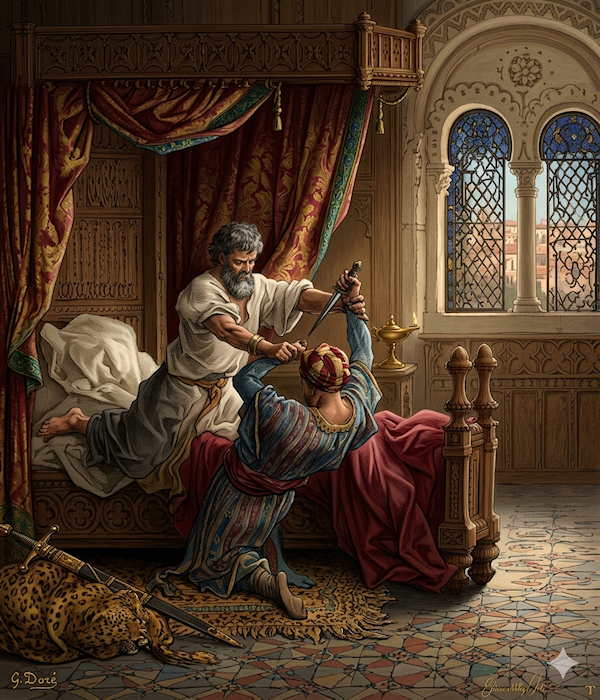
(6)Al-Malik az-Zahir Rukn al-Din Baybars al-Bunduqdari, better known under the name of Baïbars or Baybars. He was born on July 19th, 1223 north of the Black Sea in the territory of Kipchak (probably in present Crimea) and died on 1st July 1277 in Damascus. He was a Mamluk sultan of Egypt of the Bahri dynasty who reigned from 1260 to 1277.
Around 1240, he was sold as a slave and sent to Egypt. He was integrated in the Mamluk militia and entered the service of Ayyubid Sultan Salih Ayyub as bodyguard. In 1250, he actively participated in the overthrow of the Ayyubid dynasty in Cairo.
In 1260, he won an important victory against the Mongols at Ain Djalout. Back in Cairo, he overthrew the Sultan Sayf ad-Din Qutuz and proclaimed himself sultan.
Thereafter, his main objective was the destruction of the remnants of Crusader states. He captured Caesarea on 27th February 1261. In the following years, he managed to capture several important fortresses: Safed (25th July 1266), Jaffa (7th March 1268), Antioch (18th May 1268) and finally the "stunning" Krak des Chevaliers on February 8th, 1271.
He died possibly poisoned in Damascus in 1277.
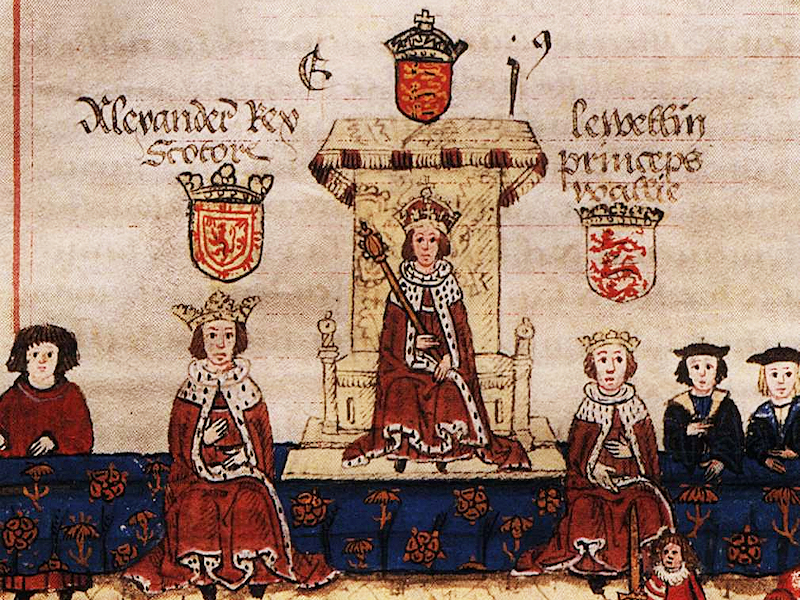
(7)Llywelyn ap Gruffydd, or Llywelyn ap Gruffudd, was born around 1220 - 1225 and died on 11 December 1282. He was the last "true" Welsh king independent of the English crown. He reigned over Gwynedd from 1255 until his death. He was one of the sons of Gruffydd ap Llywelyn Fawr (or Gruffudd ap Llywelyn ab Iorwerth), who had been ousted from the line of succession to the throne by his father Llywelyn ab Iorwerth, and of Senana ferch Caradog. When his uncle, Dafydd ap Llywelyn, died in 1246, he left the throne of Gwynedd without issue and without an heir. Following the intervention of King Henry III of England in this succession, he was appointed, along with his brother Owain Goch ap Gruffudd, co-regent of the kingdom of Gwynedd. His relationship with Henry III was far from cordial, and in 1255, Llywelyn won a significant victory over his brother at the Battle of Brin Derwin, whereupon he seized control of the entire small kingdom and had himself recognised as its sole ruler. From that point onwards, he constantly undertook new conquests to expand his territory. In 1258, he took advantage of Henry III’s troubles with his barons to secure the king’s recognition of him as the sole sovereign of the whole of Wales under the title of Prince of Wales. His alliance with Simon V de Montfort during the "Barons’ Revolt" and his expansionist ambitions at the expense of many Welsh lords made him the sworn enemy of Edward I and these Welsh lords. In En 1277, he signed the Treaty of Aberconwy with Edward I, which secured him a precarious peace. In a href="chronique-eng.html#1282">1282, war resumed against Edward I and Llywelyn was killed at the Battle of Orewin Bridge (or Irfon Bridge) on 11 December.
(8)Simon V (or VI – historians’ numbering is sometimes imprecise) de Montfort was born around 1208 and died on 4 August 1265. He was the son of Simon IV (or V) de Montfort, one of the leaders of the Albigensian Crusade, and Alix de Montmorency. In 1238, he married Eleanor of England, daughter of John I and sister of the future King Henry III. Having inherited the title of Earl of Leicester from his grandmother, Amicie de Beaumont-Leicester, he laid claim to it and was granted the title in February 1239, albeit grudgingly, by King Henry III, no doubt owing to his marriage to the king’s sister. His relations with the king deteriorated over time, to the extent that in 1258, Simon V, along with other great barons, including Roger Bigot, Earl of Norfolk, and John Fitzgeoffrey, Chief Justice of Ireland, formed an alliance to stage a sort of "coup d’état", which led Henry III to sign what history has come to call the "Provisions of Oxford". The king’s unwillingness to implement these "Provisions of Oxford" led Simon V to raise an army and fight the royal forces. After an initial victory at the Battle of Lewes in May 1264, he was killed at the Battle of Evesham the following year.
(9)The Treaty of Aberconwy was signed in November 1277 between King Edward I of England and Llywelyn ap Gruffudd, Prince of Wales. This treaty followed Edward I’s invasion of Wales to punish Llywelyn ap Gruffudd for the alliance he had formed with the English barons who had rebelled against royal authority. The treaty established a precarious peace between Wales and England. Llywelyn ap Gruffudd was permitted to retain his title of Prince of Wales, but his authority was restricted to part of his kingdom of Gwynedd. The remainder of his lands were divided between his brother Dafydd ap Gruffudd and the King of England.
(10)The Kingdom of Gwynedd is mentioned in historical sources from the late 5th to early 6th century. It covered the entire north-western part of what is now Wales, bounded (more or less) to the north-east by the River Dee and its estuary, and to the south by the Afon Mawddach and its estuary. This kingdom ceased to exist and was incorporated into the Kingdom of England following the death of its last king, Llywelyn ap Gruffudd, in 1282.
(11)Dafydd ap Gruffydd, sometimes known as Dafydd III, was probably born around 1235 and died on 3 October 1283. He was the third son of Gruffydd ap Llywelyn Fawr (or Gruffudd ap Llywelyn ab Iorwerth) and Senana ferch Caradog. He was very close to his brother Owain Goch ap Gruffudd, who appointed him military commander of his household. In 1255, the two brothers challenged their third brother, Llywelyn ap Gruffydd, but were defeated at the Battle of Brin Derwin and imprisoned. Llywelyn released Dafydd the following year and granted him lands in the Perfeddwlad, an area conquered from England along the River Dee. Dafydd spent the following years alternating between betrayals and reconciliations with his brother Llywelyn. His final change of allegiance came in 1282, when he led a rebellion of Welsh lords alongside his brother Llywelyn and his son Owain ap Dafydd. At the Battle of Orewin Bridge, Llywelyn was killed. Dafydd then seized the crown of Gwynedd, but was never officially recognised. The struggle against Edward I continued, and he was forced to flee, seeking refuge ever further afield as the English troops advanced. On 22 June 1283, Dafydd was betrayed by men from his own camp and handed over to Edward I. After being imprisoned for more than three months, he was sentenced to death on 30 September and executed in Shrewsbury on 3 October 1283.
(12)The Battle of Orewin Bridge, also known as the Battle of Irfon Bridge, took place on 11 December 1282 near the present-day Welsh village of Cilmeri (Builth Wells – Llanfair-ym-Muallt), on the banks of the River Irfon. It pitted the English armies, commanded by Roger le Strange, Lord of Ellesmere and royal adviser, Edmund Mortimer, Baron of Wigmore, and the Welsh lords of Powys (Kingdom of Wenwynwyn), against the Welsh armies of the King of Gwynedd, Llywelyn ap Gruffudd. This battle took place against the backdrop of Edward I’s second campaign to conquer Wales. Llywelyn’s army, numbering 7,000 men, occupied a hill near the small village of Cilmeri to monitor the English advance across the bridge over the River Irfon. However, the English army, tipped off by locals sympathetic to the English cause, bypassed the bridge by using a ford a few kilometres away and attacked Llywelyn’s army from the rear. Taken by surprise, the Welsh army was quickly routed and Llywelyn was killed by an English infantryman.
(13)Berwick-upon-Tweed is an English town situated in the county of Northumberland, on the east coast of England, at the mouth of the River Tweed. It is situated approximately 90 km east of Edinburgh.
(14)The Battle of Dunbar took place on 27 April 1296 near the town of the same name, situated on the east coast of Scotland, some 50 km east of Edinburgh, at the southern end of the Firth of Forth. It pitted the English army, commanded in person by Edward I and John I de Warenne, Earl of Surrey and Sussex, against the Scottish army, led by King John Balliol. That year, Edward I decided to invade Scotland to punish John Balliol for refusing to support him during his campaigns in France. After plundering and massacring the inhabitants of the town of Berwick-upon-Tweed at the end of March, Edward I’s army continued its march towards Edinburgh, following the coast towards Dunbar to capture the castle. Alerted to this, John Balliol sent his army to the town’s aid. According to historians, there was no major battle, as the English army easily put the Scottish army to flight. This first Scottish defeat marked the beginning of the end of John Balliol’s reign.
(15)Scone Abbey is situated in the village of the same name in the county of Perth, in central Scotland. It was probably founded around 1115 - 1120 during the reign of King Alexander I by Augustinian canons from Nostell Priory in West Yorkshire. It houses the Coronation Stone of the Kings of Scotland, also known as the Stone of Scone.
(16)This particular stone is the subject of numerous legends regarding its origins. One Celtic legend holds that it is one of the five talismans brought by the ‘Tuatha Dé Danann’ (the Gods of the Tribe of Dana!). Another legend suggests that it was used as a pillow by Jacob, one of the patriarchs of the Bible. Finally, yet another legend tells that it was brought to Scotland by the Egyptian princess Scota following her marriage to Prince Goídel Glas (Gaithelus), thereby founding the Gaelic lineage. Setting aside these legends, it would appear that this stone was used during the coronations of Scottish kings from the time of Coinneach mac Ailpein (Kenneth I), regarded as the founder of the Scottish monarchy. For reasons unknown, the stone was kept at Scone Abbey, which became the coronation site for the kings of Scotland, until 1296, when King Edward seized it following his victory at the Battle of Dunbar.
(17)William Wallace, sometimes known as Willam Waleys, was probably born around 1270 and executed in London in August 1305. He is thought to have been one of the sons of a certain Malcom Wallace or, according to some sources, of a certain Alan Waleys. The former is said to have been a minor knight from Elderslie, in Renfrewshire, in west-central Scotland; whilst the other was a noble vassal of the Scottish Crown in the same region. An iconic figure of the Scottish resistance, he is first mentioned alongside Andrew of Moray during the Scottish victory at the Battle of Stirling in 1297. He was then appointed Guardian of Scotland, a sort of regent of the kingdom, until his defeat the following year at the Battle of Falkirk. Forced to live in hiding, he was betrayed and captured in early August 1305 by John of Menteith, a Scottish knight allied with the King of England. He was immediately transferred to London, where he was formally charged with high treason. His trial, which lasted just one day, resulted in a death sentence. On 23 August 1305, he was executed in the manner reserved for traitors, namely by being ‘hanged, drawn and quartered’. After being beheaded as well, the various parts of his body were sent to the four corners of the Kingdom of England. His head was placed on London Bridge and the parts of his body distributed amongst Newcastle-upon-Tyne, Berwick-upon-Tweed, Stirling and Perth.
(18)The Battle of Stirling Bridge, also known simply as the Battle of Stirling, took place on 11 September 1297 near a bridge over the River Forth, close to the small Scottish town of the same name. This battle pitted the Scottish rebels, led by William Wallace and Andrew of Moray, against the English forces commanded by John I of Warenne and Hugh of Cressingham. Taking advantage of the terrain, the Scots managed to lure the English army into a bottleneck by forcing the English heavy cavalry to cross a small wooden bridge that could only accommodate two horsemen abreast. Just as half of the English cavalry had crossed, the Scots charged them with their pikemen. The English, unable to manoeuvre into a united front, were slaughtered, whilst the rest of the army fled southwards. This decisive victory, despite the death of Andrew of Moray, shattered the myth of the invincibility of the English cavalry and led to William Wallace being appointed ‘Guardian (Regent) of Scotland’.
(19)The Battle of Falkirk took place on 22 July 1298 near the town of the same name, situated a few kilometres south of Stirling. It pitted the Scottish army, led by William Wallace, against the English army, led by Edward I himself. The tactic of deploying groups of pikemen in "schiltron" formations, devised by William Wallace, was outmanoeuvred by the English, who deployed thousands of archers armed with the famous "longbows". These archers decimated the ranks of the pikemen to such an extent that the formation broke up, leaving them at the mercy of the English cavalry charges and thus sealing the Scottish defeat. William Wallace was then forced to flee the battlefield and take refuge in the north of Scotland to wage a guerrilla war, whilst the English gradually regained strategic control of much of the country for many years to come.
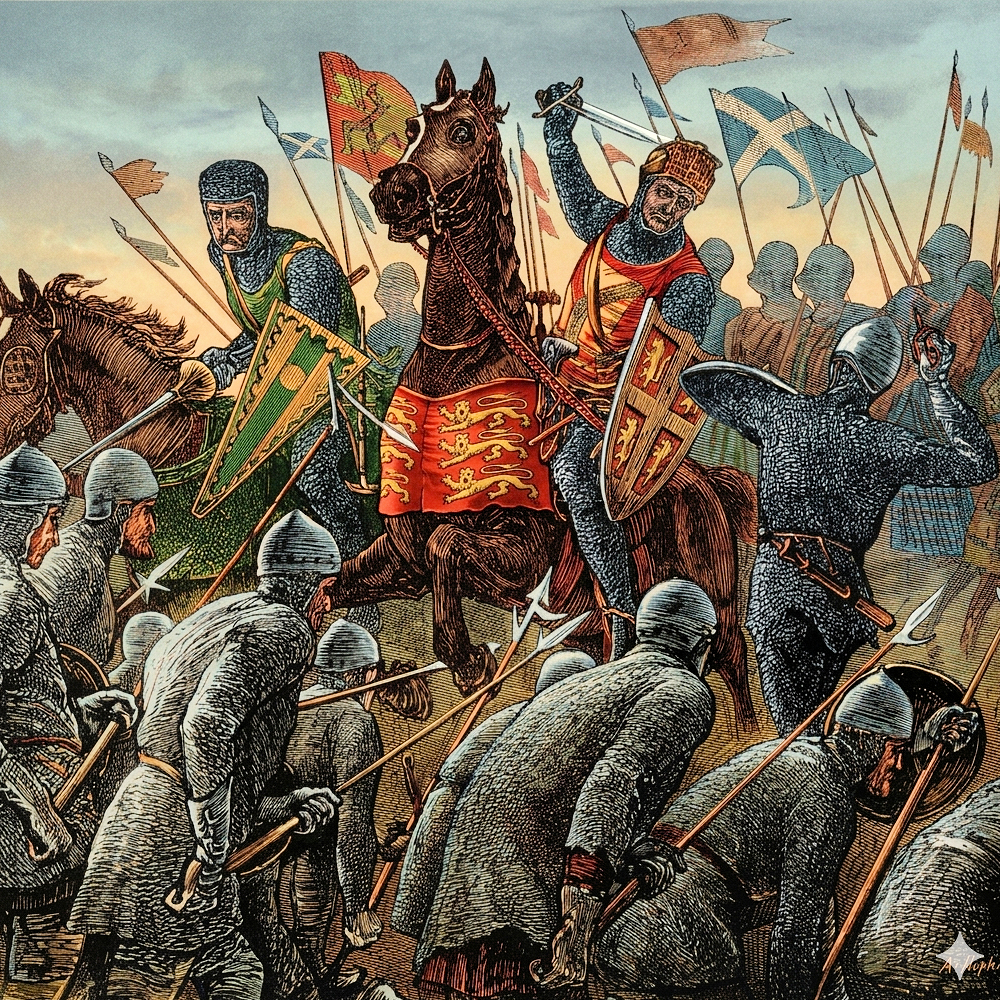
(20)The Battle of Loudoun Hill took place on 10 May 1307 near the hamlet of Allanton, close to the village of Darvel in western Scotland, on the banks of the River Irvine. It pitted the Scottish army, led by Robert I the Bruce, against the English army, led by Aymard de Valence, Earl of Pembroke. Robert used the terrain to his advantage by having trenches dug to force the English army to concentrate on a narrow front. Trapped in this man-made funnel, the English cavalry was decimated by the Scottish pikemen. This defeat forced Aymard de Valence to retreat to England and consolidated the power of Robert I the Bruce in Scotland, who rallied almost the entire nobility to his cause to continue the struggle against England.
(21)Burgh by Sands is an English village situated in the north-west of England, near the mouth of the River Eden where it flows into the Irish Sea.
 The Kings of England : Edward I "Longshanks" (o1239 - 1307+)