Projet Beaucéant   The Kings of England : Edward "the Confessor" (o1001?? - 1066+)

King of England from 1042 to 1066.

Edward was born just after the year 1000, around 1001–1004, in Islip (Oxfordshire)(1). He was the son of King Æthelred II "the Unready" and Emma of Normandy(2). He was the penultimate Anglo-Saxon king of England.
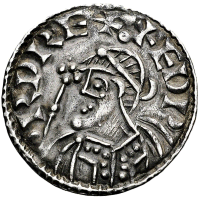
Penny à l'effigie d'Edouard le Confesseur (source : Wikipédia, l'encyclopédie libre)
Penny bearing the image of Edward the Confessor
Source : Wikipédia

In 1013, he was forced to flee England with his brother Alfred and his mother Emma following the invasion of the Danes led by Swein ""Forkbeard"(3), who seized the throne. He took refuge in Normandy with his uncle, Duke Richard II (4).
In 1014, Swein died and left the throne of England to his son Cnut "the Great"(5). Emma, now a widow, returned to England to marry Cnut and thus give him legitimacy on the throne of England.
In 1035, Cnut "the Great" died and the throne became the subject of a fratricidal struggle between two of his sons, Harold I "Harefoot"(6) and Knut II (Harthacnut)(7). Harold I reigned from 1035 to 1040 and Knut from 1040 to 1042.
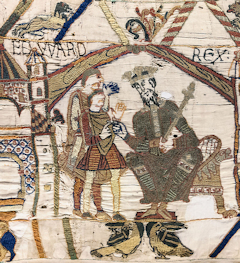
Édouard le Confesseur (première scène de la tapisserie de Bayeux) (source : Wikipédia, l'encyclopédie libre)
Edward the Confessor (first scene of the Bayeux Tapestry)
Source : Wikipédia

The death of Knut II (Harthacnut) made Edward his successor, and he ascended the throne on 8 June 1042. He was crowned at Westminster the following year.
Edward fostered his relations with Normandy by surrounding himself with numerous Norman advisers, to the detriment of the Saxons. To appease their sensibilities, in 1045 Edward married Edith, daughter of Godwin(8), the powerful Earl of Wessex(9). Despite this purely political marriage, which was never consummated, Godwin led an anti-Norman party that was joined by the Danes and a number of Saxon barons who were offended by Edward's attitude.

In 1051, a bloody riot broke out in Dover during the visit of Eustace of Boulogne(10), a close friend of the King. Godwin then stood up against the King by refusing to punish the leaders. Edward then exiled him to Flanders with his entire family and locked his wife Edith in a monastery.
The following year, Godwin returned from exile at the head of a Saxon army, aided by all the Saxon barons of the kingdom.
Faced with this show of power, the king had no choice but to restore his title of Earl of Wessex and his estates. Godwin's return was short-lived, however, as he died in 1053 after choking on a piece of bread during a royal banquet in Winchester.

It was his son, Harold Godwinson, who inherited Wessex and became the most powerful lord in the kingdom. Harold distinguished himself gloriously in various campaigns against the Welsh, and as such declared himself heir to the throne of England, thus thwarting the wishes of Guillaume, who had also declared himself successor to Edward on the basis of his kinship with him.

In January 1066, Edward died in Westminster, in the abbey he himself had founded, but without clearly designating who would be his successor.

The nature of his reign, which he wanted to be one of peace and prosperity, his great piety and his strong religious faith earned him canonisation in 1161(11).
Projet Beaucéant

Notes :

(1)A small village located about ten kilometres north of Oxford.

(2)Æthelred II, born around 966, is king of England from 978 to 1013 and from 1014 to his death in 1016. His third wife, Emma is the sister of the Duke of Normandy Richard II, the grandfather of William the Conqueror.

(3)Sweyn Ist, born around 960, is the son of the king of Denmark Harald Ist. He ascended to the throne of Denmark around 986 until his death in the beginning of 1014. He led several expeditions against the England of Æthelred in the beginning of the 11th century, as retaliation for the massacre of Saint-Brice. In 1013, he accompanied imposing troops and defeated the army of Æthelred. He was then recognized as king of England, but will rule only a few days, as he died February 3rd, 1014.

(4)Richard II of Normandy is the 4th Duke of Normandy after Rollo. He was the son of Richard I of Normandy. He became Duke of Normandy around 996 upon his father's death. He reigned for 30 years and improved the administrative organisation of the duchy to increase its power. He died in 1026.

(5)Knut the Great came from the powerful Danish house of Jelling. He was born around 994 and died in 1035. He was King of England from 1016 until his death in 1035. He was also King of Denmark from 1018 and King of Norway from 1028. He was the youngest son of Sweyn I. He accompanied his father when he invaded England in 1013. His father's death in 1014 did not stop him from continuing his conquests. In 1016, he won a crushing victory against King Edmund II ‘Ironside’ of England. Recognising Danish power, Edmund II agreed to share his kingdom with Knut. Edmund kept the south, while Knut became king of everything north of the Thames. Edmund II's unexpected death in November of the same year allowed Knut to ascend the throne and reunify the kingdom.

(6)Harold "Harefoot" was born around 1015 and died in 1040. He was the “bastard” son of Knut "the Great and his frilla (concubine) Ælfgifu of Northampton, the daughter of a certain Ælfhelm, ealdorman (earl) of Northumbria. He was regent and King of England from 1035 until his death in 1040. Taking advantage of the absence of his half-brother Knut II (Hardeknut), who was defending the kingdom of Denmark against attempted invasions by Norway and Sweden, he seized the throne of England upon the death of Knut the Great. However, he was only recognised as regent, as the Saxon nobility recognised Knut II (Hardeknut) as king. He died prematurely in 1040, just as his half-brother was preparing to invade England to reclaim the throne.

(7)Hardeknut was born around 1018 and died in 1042. He was King of Denmark from 1035 until his death under the name Knut III and King of England from 1040 until his death under the name Knut II. He was the only son born to Knut the Great and his "legitimate"’" wife Emma of Normandy. In 1035, upon the death of his father, who was also King of England and Denmark, he had to focus his military efforts on defending his throne in Denmark against attacks from Magnus I, King of Norway, and Olof III Skötkonung, King of Sweden. In 1038, he managed to reach an agreement with Magnus I to end the conflict, which also brought an end to Sweden's ambitions for the Kingdom of Denmark. Once this agreement was concluded, he prepared to invade England to challenge his half-brother Harold "Harefoot" for the throne. The latter's premature death in 1040 prevented a fratricidal military confrontation. Hardeknut nevertheless landed with his troops in Kent and was crowned king in June 1040 in Canterbury. He died suddenly in 1042 during the wedding of an important Danish lord who was a close friend of his father Knut ‘the Great’. Without children, the throne passed to Edward the Confessor, his half-brother on his mother's side, Emma of Normandy.

(8)Godwin came from a powerful Saxon family originally from the ancient Kingdom of Sussex. He will follow Æthelstan Ætheling, eldest son of King Æthelred "the Unready" in his conquests. On the death of the latter, he received a territory in Wessex. King Knut "the Great" will give him the first title of Earl of Wessex. He will have several children, among them Harold, the future king of England, Tostig and Edith to be the wife of King Edward III "the Confessor".

(9)Wessex was one of the seven Saxon kingdoms before England was fully unified in 975 by Athelstan. Its territory stretched from London to Plymouth in the far south-west of the island.

(10)Eustace II of Boulogne, born around 1015, is the son of Eustace 1st of Boulogne and of Mathilde of Leuven. He is Count of Boulogne from 1047 to 1087, and was among the faithful companions of William the Conqueror. He is a distant descendant of Charlemagne and also a distant cousin of Edward the Confessor.

(11)It would also appear that 36 years after his death, his tomb was opened and it was found that his body showed no signs of decay.

Projet Beaucéant

Previous King : Knut II - Next King : Harold Godwinson

Back to the list of Kings of England

Projet Beaucéant

BibliographyProjet Beaucéant

  1. Who's Who in British History, Early Medieval England 1066-1272
    Christopher Tyerman ; StackPole Books, 2001
  2. Kings and Queens of England - From the Saxon Kings to the House of Windsor
    Nigel Cawthorne ; Arcturus Publishing Limited, 2009
Projet Beaucéant
Templars Route European Federation

Templiers.org - Christophe Staf
All Rights Reserved

Member of the Templars Heritage Route - Route du Patrimoine Templier