The Masters of the Templar Order : Armand de Périgord (o1178 - 1244+?)
Master of the Templar Order from 1232 to 1244
Armand de Périgord, also known as Hermann de Périgueux, was a member of the family of the Counts of Périgord. Born in 1178, he joined the Order of the Temple at a very young age and served as Master of the Province of Apulia and Sicily from 1205 to 1232, when he was elected Grand Master of the Order.
From 1232 onwards, Armand de Perigord led his knights in major offensives against the towns of Cana, Saphet and Saphorie, and against the Muslim positions around Lake Tiberias.
All these expeditions served only to reduce the numbers of Templars throughout the Latin States.
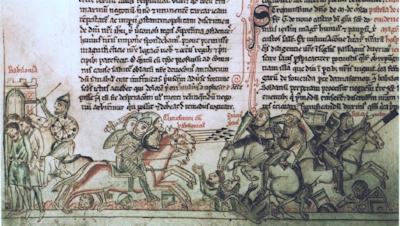
In 1236, the Syrian-Cilician border was the scene of a military disaster for the Knights Templar. 120 knights, accompanied by several hundred archers and Turcopoles, attempted to take the town of Darbsâk (Terbezek) by surprise.
Right from the start of the assault, the Templars managed to enter the lower town. But the Ayyubid soldiers regained their composure and, aided by reinforcements from the fortress, put up fierce resistance against the Templars. At the same time, cavalry reinforcements from Aleppo arrived behind the Templars and massacred them.
Of the 120 knights, fewer than 20 managed to make their way back to the Templar fortress of Baghrâs, some fifteen kilometres away.
This battle was also one of the few in which the Beauceant fell into Muslim hands, after its bearer, Reginald of Argenton(1), was cut to pieces whilst attempting to save it.
Apart from these conflicts, the early years of Armand de Perigord’s term as Grand Master were dominated by the rivalries over interests and diplomacy between the three Orders. The Knights Templar were keen to forge an alliance with the Sultan of Damascus, whilst the Knights Hospitaller and the Teutonic Knights preferred to forge closer ties with the Sultan of Cairo.
Source : Wikipédia
In September 1239, what history refers to as the "Barons’ Crusade", landed at Acre. Poorly led by the Count of Champagne, Thibaut IV, and other knights of great renown, the Crusaders paid no heed to the advice of the Masters of the Orders or the rulers of the Latin States of the East.
In November 1239, this crusade was routed by Muslim forces. The Templars, the Hospitallers and the Teutonic Knights, who had refused to join in the conquering frenzy of these French crusaders, could only gather up the few survivors and shelter them in Acre.
Armand de Périgord succeeded in securing a truce with the Sultan of Damascus(2), whilst the Knights Hospitaller secured a truce with the Sultan of Egypt(3).
In 1244, the Sultan of Damascus sought the aid of the Knights Templar to repel the Khwarazmians, a people from Asia Minor who had been driven towards Syria by the Mongol invasion.
In October 1244 the Knights Templar, the Knights Hospitaller and the Teutonic Knights – finally reconciled – alongside the Sultan of Damascus, clashed at la Forbie with the armies of the Sultan of Egypt(4), allied with the Khwarazmian troops.
On 18 October, the Franco-Muslim coalition was defeated. More than 30,000 dead from both sides littered the battlefield. Armand de Périgord was among the few knights taken prisoner. Around thirty Templars and Hospitallers managed to reach Ascalon, which was still in Christian hands.
Some historians state that Armand de Périgord was killed during the Battle of la Forbie, as was the Master of the Hospital(5). Others, however, report that he was captured and died in captivity shortly afterwards.
Be that as it may, his successor, Guillaume de Sonnac, does not appear as Master of the Templars until 1247.
Some historians name Richard de Bures as Master of the Order during the period between Armand de Perigord and Guillaume de Sonnac, whilst others refer to him only as a high-ranking dignitary, without him ever having assumed the office of Master of the Order.