
No slideshow available

 The Fortress of Arsuf
Israel, Tel Aviv District, approximately 14 km north of Tel Aviv, in the town of Herzliya, neighbourhood of Apollonia.
No slideshow available
The Fortress of ArsufIsrael, Tel Aviv District, approximately 14 km north of Tel Aviv, in the town of Herzliya, neighbourhood of Apollonia.
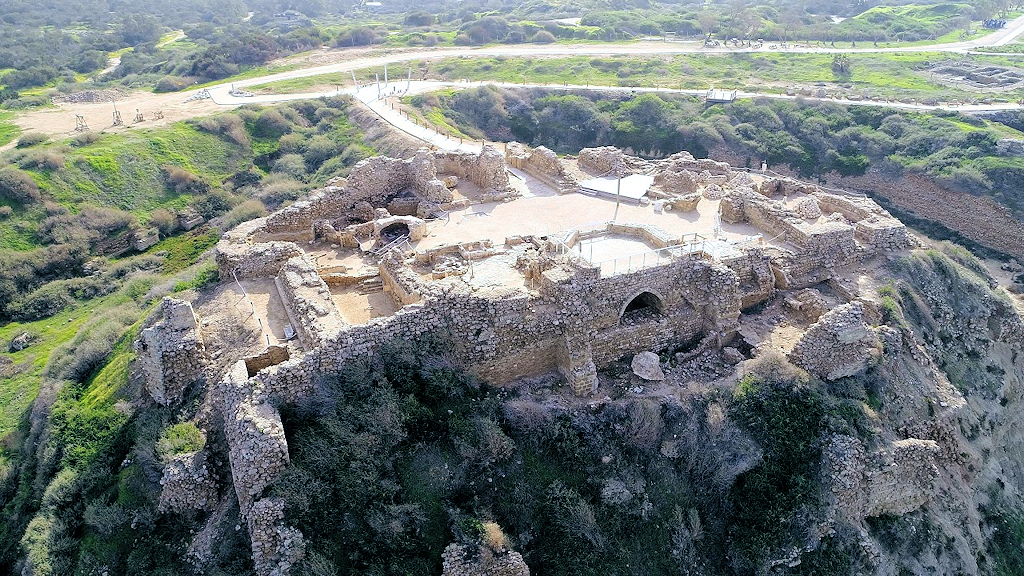
The site of Arsuf has been known since the earliest antiquity. Originally a Phoenician trading post, the site is referred to as Apollonia in the Hellenistic period.
The town experienced significant growth during the Roman period as well as during the Byzantine period. At the beginning of the 7th century, the town was conquered by the Sassanid Persians before falling into Muslim hands around the year 640. The Muslims fortified part of the town to repel attempted naval attacks by the Byzantine fleet. It was undoubtedly following this Muslim occupation that the city came to be known as Arsùf (or Arsuf).
During the First Crusade, the town was attacked on several occasions, but held out against the armies of Godfrey of Bouillon.
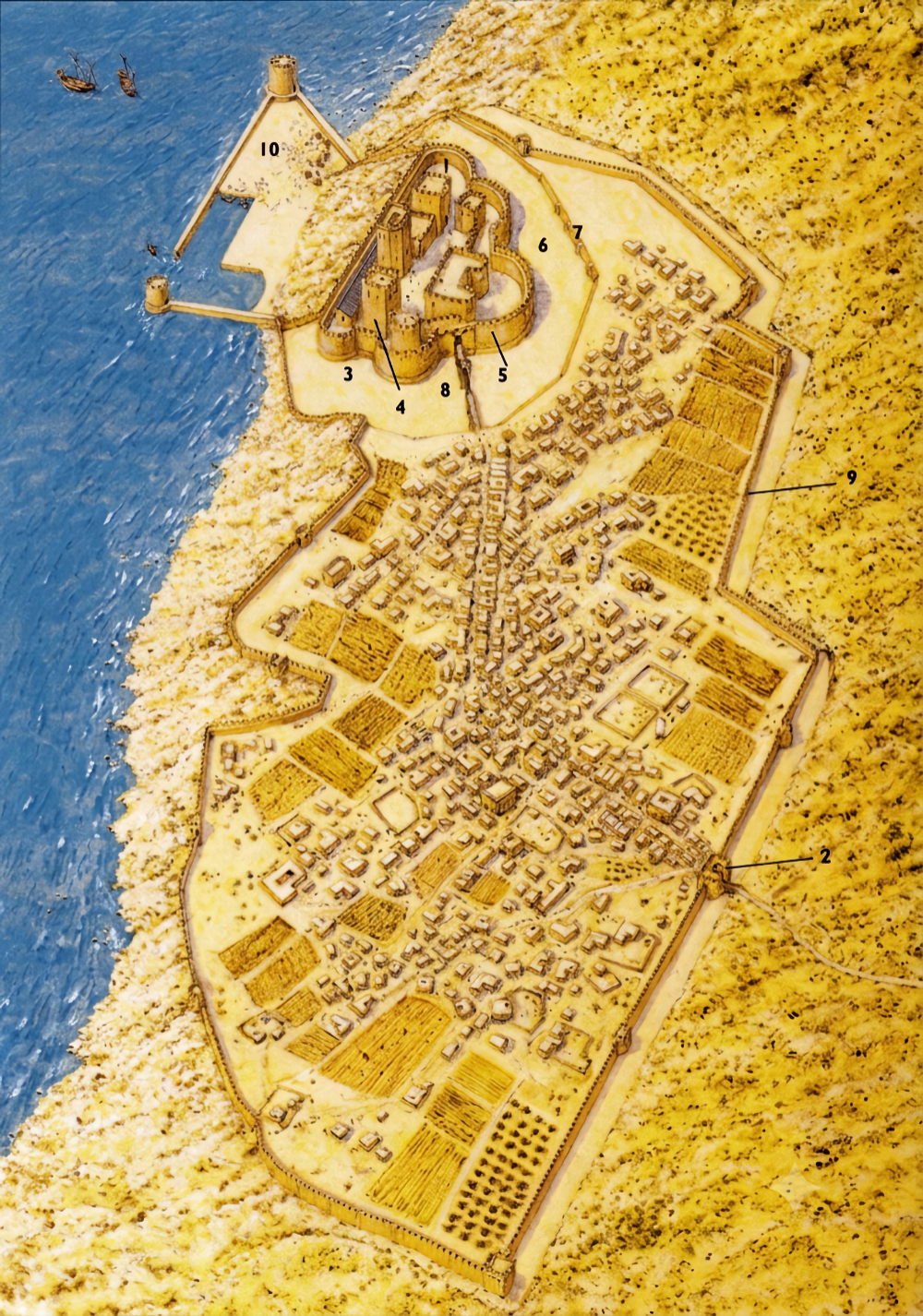
It was finally in April 1101 that Baldwin I managed to capture it with the help of a large Genoese fleet. Until 1163, the city formed an integral part of the royal domain.
In 1163, Amaury I decided to make it a vassal fief of the kingdom and entrusted it to a knight who would take the name of Jean I d’Arsouf(1). In 1177, presumably on the death of Jean I, the lordship was transferred to Guy d’Arsouf, about whom nothing is known either.
In August 1187, a few weeks after the Christian army’s crushing defeat at the Battle of Hattin, the city and its fortress fell into the hands of Saladin. In 1190, faced with the imminent arrival of the troops of the Third Crusade, Saladin ordered the demolition of its walls.
In July 1191, having succeeded in repelling Saladin’s troops who were besieging Saint-Jean d’Acre, Richard ‘the Lionheart’ , assisted by numerous Crusaders as well as the Grand Masters of the Knights Templar,Robert de Sablé, and the Knights Hospitaller, Garnier de Naplouse, set off southwards to recapture other towns that had fallen into Muslim hands. In early September, they encountered Saladin’s army between Arsouf and the Birkat Ramadan marshes, situated to the north of the city.

After an battle that was both intense and uncertain, the Christians managed to rout the Muslim army and stormed the city.
Richard then undertook the reconstruction of the town walls and its fortress, and subsequently returned the lordship to Jean II d’Arsouf (nothing is known of him either), the son of Guy. In 1198, upon his death and with no male heir to succeed him, the lordship passed to his sister, Melissende, who married for a second time in 1209 to John of Ibelin(2), then regent of the Kingdom of Jerusalem.
From 1241, John II of Ibelin(3) decided to expand and strengthen the town’s defences. He then began construction of an imposing concentric fortress on the site of the old fort to the north of the town, along the coast. In 1261, his son Balian II (4) renounced the lordship and ceded it (whether by sale or lease, the sources are unclear on this point) to theOrder of the Hospital of St John, which continued the fortification works on the town and its castle.
In March 1265, Arsuf was besieged by the Mamluk army, commanded by Baibars(5) in person. After withstanding repeated assaults by the Muslims, the Hospitaller garrison was forced to surrender at the end of April. The survivors were taken into captivity. Baibars then decided to dismantle all the fortifications, leaving the fortress in ruins.
(1)Nothing is known about this knight’s origins. He is referred to in the sources simply as Jean d’Arsouf (Johannes de Arsuth or Johannes de Arsur), with no mention of his background. He was probably a ‘Poulain’ whose father had no doubt arrived in the Holy Land during or just after the First Crusade.
(2)Jean d'Ibelin was born around 1179 and died in 1236. He was the son of Balian d’Ibelin and Marie Comnena, Queen Dowager of Jerusalem, widow of King Amaury I. He was nicknamed the “Old Lord of Beirut”. Through his mother, he was related to the family of the kings of Jerusalem and was, in effect, the “half-brother” of the future Queen Isabella of Jerusalem. In 1194, he was appointed Constable of the Kingdom of Jerusalem, succeeding Aimery II de Lusignan, who was to become King of Cyprus. Around 1200, he married Helvis, daughter of Raymond II, Lord of Nephin and vassal of the Count of Tripoli. In 1205, upon the death of Isabelle and Aimery II de Lusignan, he was appointed regent of the kingdom during the minority of his niece, the future Queen Marie of Montferrat. Presumably a widower since 1208, he remarried the following year to Melisende of Arsouf. Once his regency came to an end following the marriage of Marie to Jean de Brienne, he played an active role in the Fifth Crusade. He became regent of Cyprus in 1227 and entered into open conflict with the Holy Roman Emperor Frederick II of Hohenstaufen, which led to what history has come to know as the ‘War of the Lombards’. Seriously injured after falling from his horse in 1236, he decided to join the Order of the Temple on his deathbed.
(3)John II of Ibelin, or John of Arsouf, was born around 1211 or 1212 and died in 1258. He was the second son of John of Ibelin, Lord of Beirut and Arsouf, and Melisende of Arsouf. In his youth, he and his brother Balian were held as hostages at the court of the Holy Roman Emperor Frederick II. On his return to the Holy Land, he supported his father during the Lombard War. In 1236, he married Alix of Haifa, daughter of Rohard II of Haifa and Aiglantine of Nephin. That same year, he inherited the lordship of Arsouf upon his father’s death. He took part in the so-called ‘Barons’ Crusade in 1239 – 1240. Faced with threats from the Mamluks, he fortified Arsouf and had his fortress built. In 1247, as part of the ongoing conflict between the Papacy and the Holy Roman Empire, Henry I, King of Cyprus, appointed him Constable and Bailiff of the Kingdom of Jerusalem. He subsequently took part in the Seventh Crusade. He died in 1258 from unknown causes.
(4)Balian of Ibelin, or Balian I of Arsouf, was born around 1239 and died in 1277. He was the son of John II of Ibelin and Alix of Haifa. In 1254, he married Plaisance of Antioch, daughter of Bohemond V of Antioch and Lucienne of Segni. In 1258, he inherited the lordship of Arsouf on his father’s death and separated from his wife, who was unable to bear him any children. In 1261, he ceded (sold or leased?) the town of Arsouf and its fortress to the Order of the Hospital. He then retired to Tripoli. He was appointed Regent of Jerusalem in 1268, a title he held until his death in 1277.
(5)Al-Malik az-Zahir Rukn al-Din Baybars al-Bunduqdari, better known under the name of Baïbars or Baybars. He was born on July 19th, 1223 north of the Black Sea in the territory of Kipchak (probably in present Crimea) and died on 1st July 1277 in Damascus. He was a Mamluk sultan of Egypt of the Bahri dynasty who reigned from 1260 to 1277.
Around 1240, he was sold as a slave and sent to Egypt. He was integrated in the Mamluk militia and entered the service of Ayyubid Sultan Salih Ayyub as bodyguard. In 1250, he actively participated in the overthrow of the Ayyubid dynasty in Cairo.
In 1260, he won an important victory against the Mongols at Ain Djalout. Back in Cairo, he overthrew the Sultan Sayf ad-Din Qutuz and proclaimed himself sultan.
Thereafter, his main objective was the destruction of the remnants of Crusader states. He captured Caesarea on 27th February 1261. In the following years, he managed to capture several important fortresses: Safed (25th July 1266), Jaffa (7th March 1268), Antioch (18th May 1268) and finally the "stunning" Krak des Chevaliers on February 8th, 1271.
He died possibly poisoned in Damascus in 1277.

Templiers.org - Christophe Staf
All Rights Reserved
Member of the Templars Heritage Route - Route du Patrimoine Templier