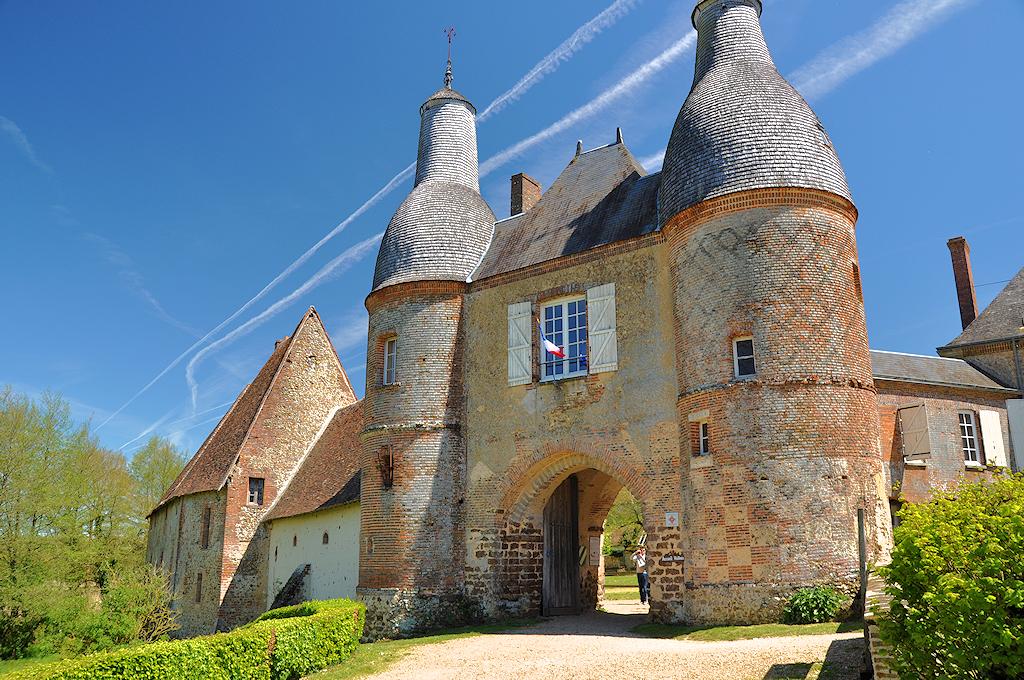
 The House of Arville
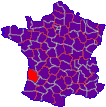
France, Department of Loir-et-Cher (41), approximately 30 km west of Châteaudun and approximately 15 km north of Montdoubleau, commune of Couëtron-au-Perche, hamlet of Arville.
The House of ArvilleFrance, Department of Loir-et-Cher (41), approximately 30 km west of Châteaudun and approximately 15 km north of Montdoubleau, commune of Couëtron-au-Perche, hamlet of Arville.
It is not known exactly when the Templars settled in Arville, but some believe this took place shortly after the Council of Troyes, and therefore sometime between the 1130s and the 1140s. They base this dating on a charter from the Abbey of Saint-Denis(1) in Nogent-sur-Rotrou, dating from ‘the same period’ (though without specifying an exact date), in which the name of Brother Guillaume d’Arville is mentioned.
This initial donation is said to have been made by Geoffroy III, Viscount of Châteaudun(2), and consisted of an "unspoilt" forest estate covering approximately 1000 hectares.
What is certain, in any case, is that in 1180, Hugh IV, Viscount of Châteaudun(3), granted the Temple of Arville the right to graze 20 cows and 10 pigs all year round in the woods he owned near their house.
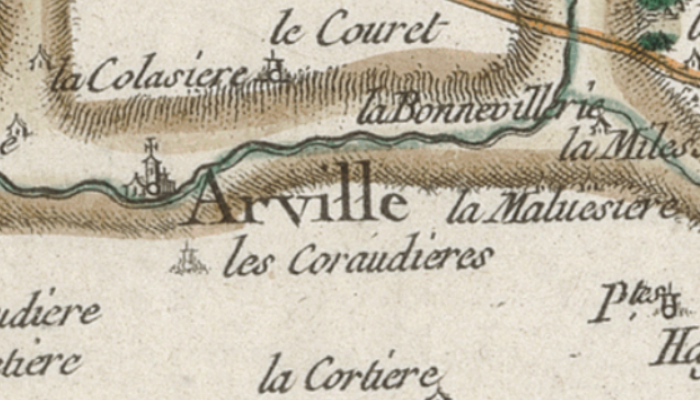
In 1208, a charter concerning the Temple of La Bourdinière mentions Robert d’Avelin as Commander of Arville and two brothers of the Order, Laurent and Garin, as witnesses to the settlement of a property dispute with the Count of Chartres.
A final charter, dated 1270, tells us that Sir Baudouin of Cornwall and his wife bequeathed themselves and their property to the House of the Temple of Jerusalem in Arville.
Following the dissolution of the Order of the Temple in 1312, the house in Arville became the property of the Order of the Hospital.
During the Hundred Years’ War(4), the Arville estate suffered such extensive destruction and devastation that, in 1410, a decree issued by the chapter of the Order of the Hospital granted the inhabitants of Arville permission to pay only half the dues they owed to the Order, on account of the damage caused by the English.
Towards the end of the 15th century, the Arville estate, which was in a state of disrepair as evidenced by the report of a priory inspection in 1495, became a dependency of the Sours estate.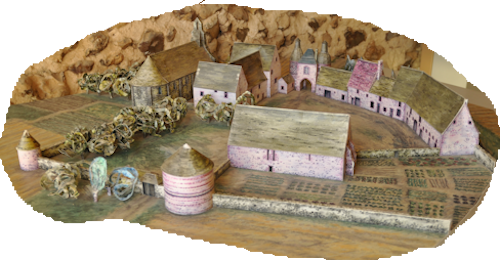
In the 17th century, the Aville estate was rebuilt and flourishing. Another account of a visit mentions that it comprised a beautiful estate surrounded by a moat, with grounds covering 80 arpents, including hare enclosures, gardens and orchards...
At that time, the House of Arville owned numerous farms and smallholdings situated in several neighbouring parishes, namely : in the parish of Arville, the smallholdings of La Colasserie, La Louche-la-Pierre and L’Atre Guillaume, as well as the farm of La Provenderie; in the parish of La Chapelle-Guillaume, the smallholding of La Pinterie; in the parish of Etilleux, the smallholding of La Chenaie; in the parish of Saint-Mexent, the smallholding of Le Temple; and in the parish of Gault, the farm of La Gravasière.
Today, the Arville Commandery remains, owing to the scale of its existing buildings, a unique complex and one of the best-preserved commanderies in France.
Description of the existing buildings :

(1)The Abbey of Saint-Denis in Nogent-le-Rotrou was probably founded around 1029 by Benedictine monks, thanks to a donation made by Geoffroy III, Lord of Nogent-le-Rotrou. It subsequently passed to the Order of Cluny in 1080. In the mid-13th century, the abbey began a slow but inexorable decline.
(2)Sometimes referred to as Geoffrey IV of Mondoubleau (by marriage). He was Viscount of Châteaudun from 1110 to 1140. He was the son of Henry III, Viscount of Châteaudun, and Agnes of Freteval. He was born around 1090. In 1110, he married Avoise (Helvise or Havise) de Mondoubleau. He took part in an expedition to the Holy Land and died on his return to France, in Chartres, in 1140.
(3)Hugh IV was Viscount of Châteaudun from 1150 to 1180. He was born around 1135 and died in 1180. He was the son of Geoffrey III of Châteaudun and Helvise of Montdoubleau. In 1159, he made a pilgrimage to Jerusalem. Around 1150, he married Marguerite de Saint-Calais, with whom he had six children.
(4)The Hundred Years’ War was an intermittent conflict between the Kingdom of France (the Valois) and the Kingdom of England (the Plantagenets) which began in 1337 with the Battle of Cadzand (in Flanders, at the mouth of the Scheldt) and ended unofficially in 1453 after the Battle of Castillon, and officially in 1475 with the signing of the Treaty of Picquigny.

Templiers.org - Christophe Staf
All Rights Reserved
Member of the Templars Heritage Route - Route du Patrimoine Templier