
No slideshow available
 The Commandery of Rheinfelden
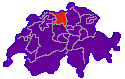
Switzerland, Canton of Aargau (Argovia), about 18 km east of Basel, on the left bank of the Rhine, municipality of Rheinfelden.
No slideshow available
The Commandery of RheinfeldenSwitzerland, Canton of Aargau (Argovia), about 18 km east of Basel, on the left bank of the Rhine, municipality of Rheinfelden.
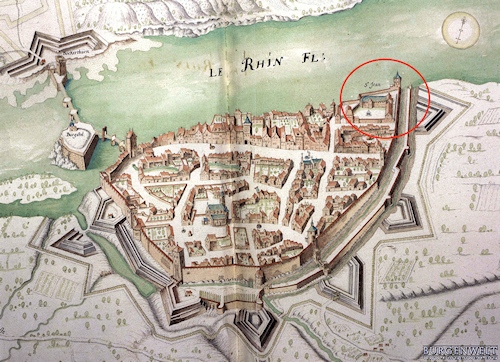
The commandery of Rheinfelden Commandery was founded in 1212, when Berchtold V von Zähringen(1), Lord of Rheinfelden, donated an estate situated outside the city walls, on the left bank of the Rhine, to the Order of St John..
Following this initial donation, and no doubt also thanks to Berchtold’s reputation, many local lords contributed to the development of the commandery. Its estates soon expanded on both sides of the Rhine, into the surrounding villages, as well as into the suburbs of Basel and Mulhouse.
At the end of 1448, or at the beginning of 1449 – historians disagree on the date – a band of mercenaries led by Hans von Rechberg(2) attacked and sacked the town. The commandery, situated outside the walls, was completely destroyed. The Commander and Grand Prior of Germany, Johann Loesel(3), then set about finding a site within the city walls on which to rebuild the commandery, which can still be seen today.
When, around 1525, the city of Basel became a centre of the Reformation, its commandery was dissolved and the hospitaller brothers who were based there took refuge in Rheinfelden, which had remained Catholic.
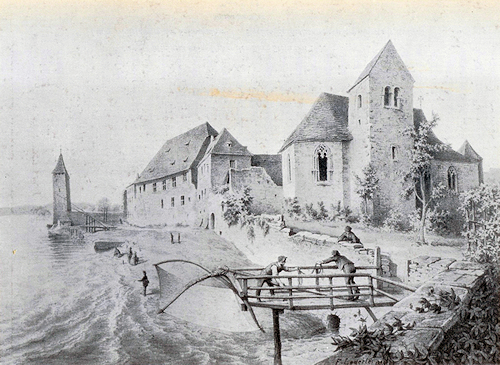
Shortly afterwards, the commandery faced serious financial difficulties and was forced to sell off its property and estates bit by bit in an attempt to limit the damage, but its decline was inevitable. The commandery was finally closed down in the early 19th century by the authorities of the canton of Aargau.
In 1813, Franz Joseph Dietschy, founder of the Salmenbräu brewery, bought the commandery estate, thereby saving it from demolition, and set up a new farm there.
(1)Berchtold (or Berthold) V von Zähringen was born around 1160 and died in February 1218 in Freiburg im Breisgau. He was the son of Duke Berthold IV von Zähringen and Heilwich von Frohburg, daughter of Count Volmar II von Frohburg. He succeeded his father in 1186, upon the latter’s death. In 1212, he married Clémence d’Auxonne, daughter of Étienne II d’Auxonne (or Burgundy-Comté) and Béatrice de Chalon. In 1198, he was tipped to succeed Emperor Henry VI but withdrew in favour of Philip I of Swabia. On his death, he had no successor and was therefore the last Duke of Zähringen.
(2)Hans von Rechberg was born around 1410 and died in November 1464. He was the fourth and youngest son of Heinrich von Rechberg and Countess Agnes von Helfenstein. In 1437, on his father’s death, he inherited the lordship of Gammertingen-Hettingen in Baden-Württemberg. From a very young age, he served in various armies and took part, notably, in the war against the Hussites in 1431 and in the war between the nobility of the Hegau and the Bishop of Constance in 1440–1441; he was a captain in the Habsburg forces during the First Zurich War in 1443 and became captain of the town the following year. In 1448–1449, he attacked Rheinfelden. In the 1450s, he sold his estate to settle in and acquire land in the Black Forest. There, he had Hohenschramberg Castle built around 1455. He continued to be embroiled in disputes with the local lords. During a raid in the autumn of 1464, he was wounded and died a few days later from his injuries.
(3)Johann Loesel was born around 1390 and died in 1460. He was originally from Strasbourg and joined the Order of the Hospital of St John at an Alsatian commandery, probably around 1410. After serving as commander of Mainz, he was appointed commander of the Rheinfelden commandery in 1434. In 1440, he was appointed Grand Bailiff of Rhodes, a position within the Order specifically reserved for a member of the German Language, responsible for the city’s fortifications. In 1444, he was appointed Grand Prior of Germany; he then left Rhodes and resigned from his post as Grand Bailiff to return to Europe. In addition to the commandry of Rheinfelden, which he had not relinquished, he was entrusted with the commandries of Basel, Bubikon, Leuggern and Wädenswil, the latter being his principal residence. Following the destruction of Rheinfelden in 1449 by Hans von Rechberg, he travelled to the court of Duke Albrecht VI of Austria, from whom he obtained permission to have it rebuilt. He probably died on 8 April 1460 in Basel and was most likely buried in the commandery’s church, which no longer exists.

Templiers.org - Christophe Staf
All Rights Reserved
Member of the Templars Heritage Route - Route du Patrimoine Templier