
No slideshow available
 The Castle of Riba-Roja
Spain, province of Tarragona, approximately 80 km west of Tarragona, municipality of Riba-Roja d’Ebre.
No slideshow available
The Castle of Riba-RojaSpain, province of Tarragona, approximately 80 km west of Tarragona, municipality of Riba-Roja d’Ebre.
Although archaeological excavations indicate that the site has probably been occupied since the Iron Age, the settlement and the founding of the village of Riba-Roja date back to the mid-12th century, during the Christian reconquest of the region.
Riba-Roja was most likely conquered by the Christian armies of Ramon Berenguer IV(1), the Count of Barcelona, at the same time as Miravet, Ascó and Tortosa, around 1153.
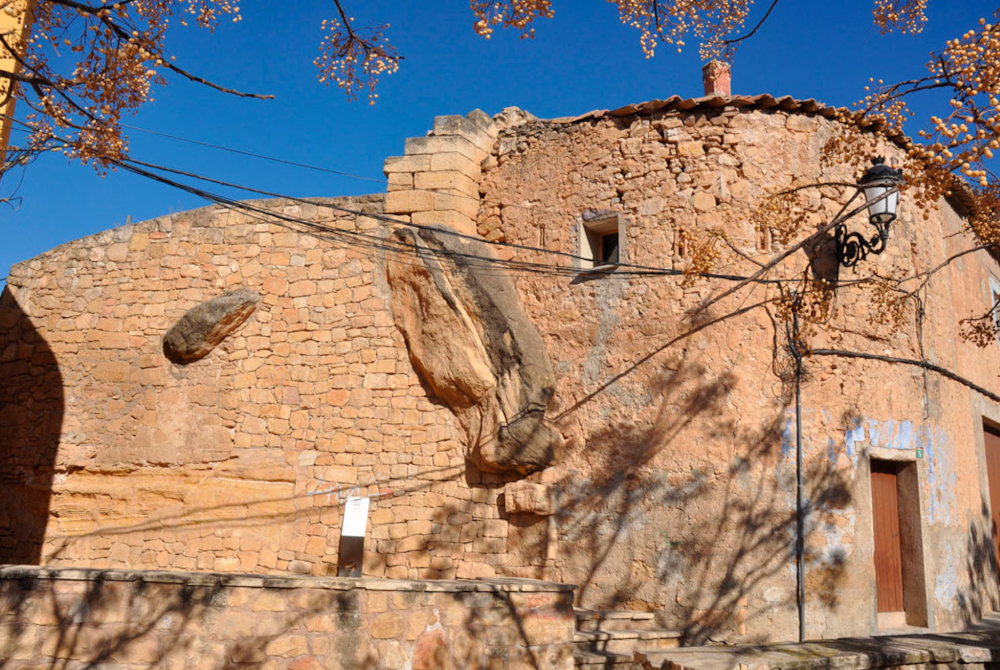
Having long remained under royal administration, it was not until 1175 that King Alfonso II, facing a serious financial crisis, mortgaged the administration of the strongholds of Riba-Roja and Castelló d'Empúries to the Order of the Temple. In 1182, the Order became the full owner of the entire Riba-Roja estate, at the same time as the donation of Ascó.
In 1277, Riba-Roja was separated from Ascó to become a commandery in its own right. In 1279, the name of the commander of Riba-Roja, Brother Robert, appeared for the first time in the archives, without any further details.
At around the same time, towards the end of the 13th century, the commandery of Riba-Roja found itself caught up in the struggle between two powerful noble families, the Houses of Entença and Montcada(2). The Templars, who were more or less "allies" of the Montcada clan, suffered acts of vengeance and retaliation at the hands of the opposing clan; for example, they were forced to pay a heavy ransom to secure the release of a group of villagers who had been abducted by the Entença clan’s henchmen.
Following the dissolution of the Order of the Temple in 1312, Riba-Roja passed into the hands of the Order of Saint John of Jerusalem, which incorporated it into the commandery of Vilalba dels Arcs.
Unfortunately, there are now virtually no architectural remains from the Templar period left in Riba-roja.
(1)Raimond-Bérenger (Ramon-Berenguer) IV of Barcelona, known as "the Saint". He was born in Barcelona in 1113 and died in Borgo San Dalmazzo, Italy, in 1162. He was Count of Barcelona, Girona, Cerdanya and Osona, Ribagorce and Prince of Aragon. He was the son of Raimond-Bérenger III, Count of Barcelona, and Dolça, daughter of Gilbert I, Viscount of Gévaudan, and Gerberge d'Arles, Countess of Provence. He inherited his various counties upon his father's death in 1131. In 1137, he signed a marriage agreement with Ramire II, King of Aragon, who promised the hand of Petronilla (born the previous year) to the Count of Barcelona as soon as she reached the legal age of 14. The marriage took place in 1150. The signing of this agreement allowed him to unite his own domains with those of the Crown of Aragon and to bear the titles of Prince of Aragon and Count of Ribagorza. Taking advantage of the weakening of the Almoravids, he conquered several large cities in the south of his territory, including Almería, Tortosa and Lleida. His reign was also affected by the war he waged against his Christian neighbours to the north, the Counts of Toulouse and Provence, in what history calls "The Great Southern War". While crossing the Alps to meet Emperor Frederick I "Barbarossa" in Turin, he fell ill and died in early August 1162.
(2)This "civil" war between the Houses of Entença and Montcada in Catalonia at the end of the 13th century stemmed from a direct struggle for influence over the territorial, economic and strategic control of the lower Ebro basin. As owners of neighbouring estates, these two clans clashed over the collection of tolls on the Ebro, control of agricultural land and possession of strategic border castles. This rivalry resulted in a series of extremely destructive private military campaigns, characterised by the siege of fortresses, ambushes and punitive raids, often involving Almogavar mercenaries. The escalation of violence between these two clans caused such destabilisation in the region that King Alfonso III and his successor, Jayme II, were forced to intervene militarily and legally in the conflict. Royal authority ultimately compelled the two factions to enter into enforced truces and submit to judicial arbitration, curbing the use of private armies and gradually bringing the high nobility under the direct authority of the monarchy.


Templiers.org - Christophe Staf
All Rights Reserved
Member of the Templars Heritage Route - Route du Patrimoine Templier