Projet Beaucéant   The Kings of England : Edgard Ætheling (o1050 - ????+)

He was recognised as King of England by the Witenagemot(1) upon the death of Harold Godwinson in October 1066, but was never crowned due to the Norman invasion and the accession to the throne of William I, known as William the Conqueror.

He was the son of Edward "the Exile" and Agatha(2). He was probably born around 1050 while his father was in exile at the court of the King of Hungary, András 1er.
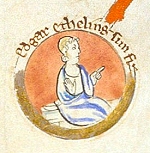
Source : https://fr.wikipedia.org/wiki/Edgar_Atheling
Edgard Ætheling
Source : Wikipédia
Portrait of Edgar in a 13th-century royal genealogy (British Library Royal MS 14 B V).

In 1057, Edward "the Exile" was recalled to England with his family by King Edward "the Confessor", but died suddenly shortly after his arrival on the island. Although he was the last male representative of Cerdic's family of Wessex(3) and, as such, last in line to the Saxon throne, there is no conclusive evidence that Edward "the Confessor" did anything to associate him with the throne and make him his successor.

After the defeat at Hastings in 1066, the Witan, led by the last important Saxon lords(4), recognised him as the successor to Harold Godwinson.

However, the deployment of the Normans across the country and the imminent arrival of William I at the gates of London caused the Saxon clan to scatter. When William crossed the Thames at Wallingford(5), he was welcomed by Stigand(6), who immediately submitted to him.

The Norman siege of London brought about the dissolution of the Saxon council, and in early December 1066, the last representatives of the Witan, along with Edgar Ætheling, appeared before William I in the village of Berkhamsted(7) and submitted to him.

After William I ascended to the throne, Edgar Ætheling was sent into exile in Normandy along with several Saxon earls, including Edwin of Mercia(8), Morcar of Northumbria(9), and Waltheof(10). They returned to England at the end of 1067 or early 1068 to settle at William's court.
Edgar Ætheling quickly fled the court and went to Scotland, where he took refuge at the court of King Malcolm III Canmore.

In 1072, after the Treaty of Abernethy(11) was concluded between Malcolm III and William I, Edgar Ætheling was forced to leave the island and seek refuge in Flanders, with Count Robert "the Frisian"(12).

Around 1078 - 1079, Edgar Ætheling returned to England and reconciled with William I. He then became friends with William's son, Robert "Curthose"(13).

In 1086, he received permission from William I to raise troops and arm a fleet to go and fight in Apulia alongside the Normans of Roger "Borsa", successor of Robert "Guiscard".
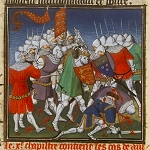
Source : Wikipédia, l'encyclopédie libre - La Bataille de Tinchebray
Battle of Tinchebray
Source : Wikipédia
Bibliothèque nationale de France, Département des Manuscrits, Division occidentale, Français 226, fol. 256v, Bataille de Tinchebray (1106)

Returning to England after William's death, he obtained permission from Robert "Curthose", who had become Duke of Normandy, to settle on his lands and was granted an estate there. But in 1091, Robert "Curthose" and his brother William II "Rufus" settled their dispute with the Treaty of Caen(14).
This reconciliation between the enemy brothers resulted in Edgar Ætheling being expelled from Normandy and forced to seek refuge once again at the court of Malcolm III of Scotland.

He then encouraged him to attack the English possessions in the north, but they came up against a coalition led by William II and his brother Robert. After several battles between the two clans, Edgar and Robert met and negotiated a truce between the two sides at the end of 1091.

In 1093, Donald ascended the throne of Scotland upon the death of Malcolm III, but William II recognised Edgar, one of Edgar Ætheling's nephews, as King of Scotland.

In 1095, after subduing Robert de Montbray(15), who had plotted against the King of England, Edgar Ætheling led the Anglo-Norman army that invaded Scotland to place his nephew Edgar on the throne.

In 1100, upon the death of William II, his niece Matilda (or Edith) married the king's brother and successor, Henry I "Beauclerc".

In 1106, he once again stood alongside Robert "Curthose" in his fight against the new King of England. He was taken prisoner at the Battle of Tinchebray(16) at the same time as Robert.

Quickly released by King Henry I "Beauclerc", he then retired to his Norman estates and disappeared from historical records.
Projet Beaucéant

Notes :

(1)The Witenagemot or Witan was a assembly of wise men of the Saxons. This assembly, operating almost as a sort of parliament, was composed of influential men of the kingdom, the clergy, the Earls and Thegns.

(2)Also called Edward of Outremer or Edward Ætheling. He was born around 1016 and died in 1057. He was the son of King Edmund II "Ironside" and Ealdgyth (Edith). He was called "the Exiled" because he spent most of his life away from England, mainly in Denmark.
He escaped an assassination attempt orchestrated by King Knut the Great, and he took refuge at the court of Prince Yaroslav of Kiev. There, he married a daughter of the prince. After his marriage, he moved to Hungary, where his uncle Edward "the Confessor" meanwhile become King of England, recalled him and designated him as his heir. He died a few days after his return to English soil.

(3)Cerdic is of unknown origin. He is mentioned for the first time in the "Anglo-Saxon Chronicle" (set of annals in Old English relating the history of the Anglo-Saxons). The original manuscript of this chronicle dates of the end of the 9th century. He was born around 470 and died in 534. He became the first king of Wessex from 519 to 534. He is considered as the ancestor of various English and British royal dynasties to the house of Windsor.

(4)Stigand, Archbishop of Canterbury, Ealdred, Archbishop of York, and Harold Godwinson's two brothers-in-law: Edwin, Earl of Mercia, and Morcar, Earl of Northumbria.

(5)Wallingford is a town in Oxfordshire, England. It is located approximately 20 kilometres south-east of Oxford, on the River Thames.

(6)Stigand comes from a wealthy family of Anglo-Scandinavian origin. We don't know his birthdate, but it seems that it was at the end of the 10th or the early beginning of the 11th century. He is first admitted to the Court of king Knut the Great as chaplain before become one of his councilors.
Under the reign of Edward III "the Confessor", he is among the most important of his councilors. He is appointed Bishop of Elmham in 1043, and then Bishop of Winchester four years later. In 1052, he is appointed Archbishop of Canterbury. He died in 1072.

(7)Berkhamsted is a town in Hertfordshire, located approximately 60 kilometres east of Oxford and 50 kilometres north of London.

(8)He became Earl of Mercia at the death of his father Ælfgar in 1062.
He is the eldest son in a family which is also composed of Morcar, the future Earl of Northumbria and Edith, the future wife of Harold Godwinson.
In 1071, as the two brothers try to raise Mercia again against William 1st "The Conqueror", Edwin is betrayed by his escort and killed.

(9)He became Earl of Northumbria in 1065, after a peasant revolt ousted Tostig Godwinson from the throne of the County. He was the second son of Ælfgar of Mercia. His older brother was Edwin, the future Earl of Mercia and his sister Edith's, future wife of Harold Godwinson.
In 1066, he was defeated at the Battle of Fulford by an army led by Tostig Godwinson and King Harald III of Norway.
In 1071, as the two brothers try to raise Mercia again against William 1 'The Conqueror', Edwin is betrayed by his escort and killed. Some time later, Morcar is captured and will finish his life in Norman jails at an unknown date.

(10)Waltheof Siwardson of Northumbria. He was born around 1050 and died executed on May 31st 1076. He was the second son of the Earl Siward of Northumbria, who died in 1055. The death of his older brother, much older than him the previous year, made him the heir to the County. But his being too young prompted King Edward III to name Tostig Godwinson as Lord of the County.
At the end of the year 1066, he submitted to William "the Conqueror", who finally gave him the Northumbria County. But in 1075, he participated in a plot against the king. Arrested, he was judged and sentenced to death. He was beheaded May 31st 1076 in Winchester.

(11)The Treaty of Abernethy, signed in 1072 by William I "the Conqueror", King of England, and Malcolm III of Scotland, brought an end to four years of conflict between the two kingdoms. Around 1068, Edgar Ætheling, the last Saxon pretender to the English throne, fled and sought refuge at the court of Malcolm III of Scotland. Malcolm III took up Edgar Ætheling's cause, marrying his sister Margaret and launching devastating raids throughout northern England, thereby challenging William's authority. William I responded by counterattacking with a large army, both land and sea. Malcolm III's troops were defeated several times and, unable to counter the Norman power, he resolved to meet William I at Abernethy, a small village in Perthshire, located about 70 kilometres north of Edinburgh, at the mouth of the River Tay. By signing this treaty, the details of which are unknown as no original documents survive to this day, Malcolm III recognised William's sovereignty over England and paid him homage, thus becoming his vassal. This situation of Scottish vassalage poisoned relations between the two kingdoms for centuries.

(12)Robert 1st of Flanders, also called Robert "the Frisian". Born about 1035, died on October 13th 1093. He was the second son of Count Baldwin V and Adele of France. On the death of his elder brother, Baldwin VI, Count of Flanders, he dispossesses Arnulf III, son of the latter, of his throne and became Count of Flanders from 1071 to 1093.

(13)Robert II of Normandy, also called Robert "Curthose". Born about 1051, died in February 1134. He was the eldest son of William 1st "the Conqueror" and inherited the Duchy of Normandy in 1087 at the death of his father. He also fought over the succession to the throne of England with his two younger brothers, the future kings William II and Henry 1st. In 1106, he was captured at the Battle of Tinchebray and imprisoned. He died while he was imprisoned in Cardiff Castle on February 3rd 1134.

(14)The Treaty of Caen, signed in 1091, attempted to end the fratricidal war between William II "Rufus", King of England, and his elder brother Robert "Curthose", Duke of Normandy, over the inheritance of their father, William I "the Conqueror". This conflict began in 1087, when the separation of the Crown and the Duchy created a dilemma of loyalty for barons who owned land on both sides of the Channel. After an English invasion of Normandy, the two brothers chose negotiation rather than a final confrontation. Under this agreement, William II retained the counties of Eu and Aumale as well as Cherbourg, while in return he undertook to help Robert reconquer the rebellious lands of Maine and subdue their younger brother, Henry, the future King Henry I Beauclerc, who had taken refuge at Mont-Saint-Michel. The most important point of the treaty stipulated that if either brother died without a male heir, the other would inherit all of the Anglo-Norman domains, foreshadowing the future reunification of the kingdom and the duchy under the sole authority of the king.

(15)Robert Mowbray (Montbray) came from a powerful Anglo-Norman family. He was born around 1060 and died at an unknown date between 1115 and 1125. He was Earl of Northumbria between 1087 and 1095. In 1095, he rebelled against King William II "Rufus" but was captured. He was taken captive in Windsor where he died between 1115 and 1125.

(16)his battle took place on September 28th 1106 near the town of Tinchebray in Normandy (about 65 km south west of Caen and 50 km east of Avranches). It opposed the armies of the two warring brothers: The King of England Henry I also called "Beauclerc" and the Duke of Normandy Robert Curtehose.
The King of England won a resounding victory and Robert Curthose is captured and taken to prison where he died in 1134. The victory also allowed Henry 1st to link Normandy to his kingdom.

Projet Beaucéant
Projet Beaucéant

BibliographyProjet Beaucéant

  1. Who's Who in British History, Early Medieval England 1066-1272
    Christopher Tyerman ; StackPole Books, 2001
  2. Kings and Queens of England - From the Saxon Kings to the House of Windsor
    Nigel Cawthorne ; Arcturus Publishing Limited, 2009
Projet Beaucéant
Templars Route European Federation

Templiers.org - Christophe Staf
All Rights Reserved

Member of the Templars Heritage Route - Route du Patrimoine Templier