The Masters of the Templar Order : Arnau de Torroja (o1118/1120 - 1184+)
Master of the Templar Order from 1180 ou 1181 to 1184
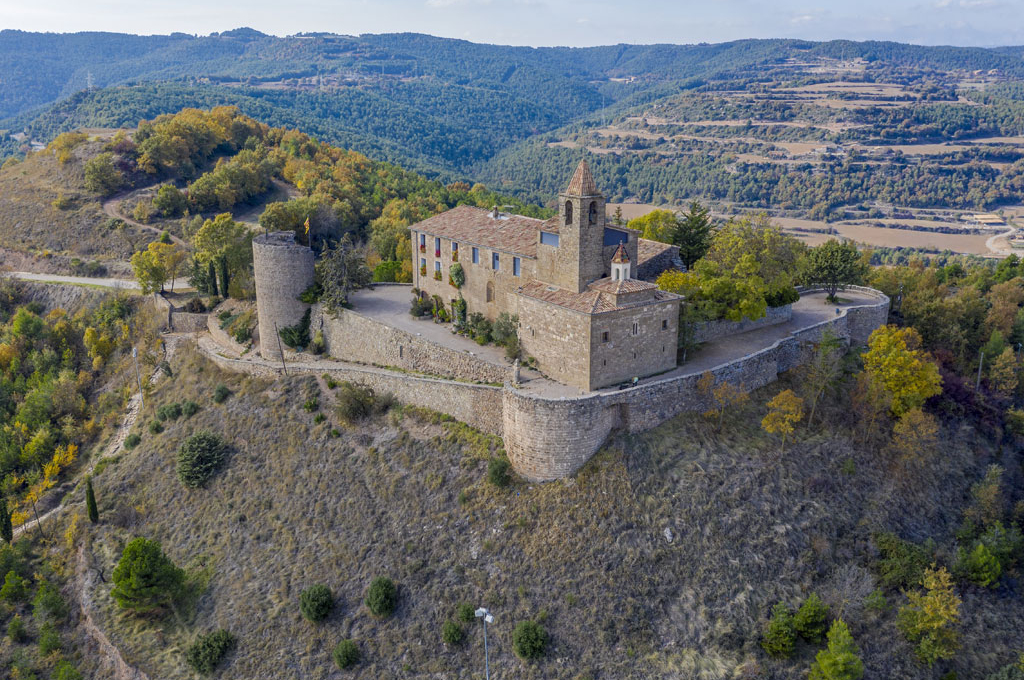
Arnau de Torroja (known in France as Arnaud de Toroge) came from an influential Catalan noble family based in Solsona(1) and closely associated with the Counts of Urgell and the Counts of Barcelona.
He was one of the younger sons of Bernat Ecard de Torroja and his wife Valença. He first appears in records in 1132, which would suggest that he was born around 1118 - 1120, most likely at Solsona Castle.
Apart from being mentioned in documents alongside his parents in the 1130s – 1140s, little is known about his early years. At some point, he was no doubt sent to the court of Ramon Berenguer IV, Count of Barcelona(2), as a squire to complete his training in the art of warfare. It was also at this time that, alongside the same count, he took part in several campaigns against the Almoravids, who had seized the Taifa kingdoms of Tortosa and Zaragoza. During this period, he also appears in numerous documents as a witness for Ramon Berenguer IV, indicating that he held a certain status at the count’s court.
Source : https://www.tuscasasrurales.com
In 1148, he was part of Ramon Berenguer IV’s army during the capture of the city of Tortosa, and the following year he was also present during the capture of the city of Lleida (Lérida). It was undoubtedly at this time that he first came face to face with the Knights Templar, who took part in the capture of these two cities alongside the count.
No doubt deeply impressed by the Templars’ way of life, in 1153 he donated to Pere de Rovira, Master of the Province, the estates he had received from Count Ramon Berenguer IV in the town of Tortosa immediately after its conquest. A little later that year, he also donated to them some of the estates he had received in the town of Lérida.
Although he was nearly 45 years old, Arnau took a radical decision and chose to join the Templar Order. He was thus admitted to the Order at Gardeny Castle at the end of December 1162.
As soon as he joined the Order, and no doubt thanks to his own qualities and his family’s reputation amongst the Count of Barcelona’s entourage, Arnau de Toroja accompanied the new Provincial Master, Hug Gaufred, on his inspection tours of the Provençal, Catalan and Aragonese commanderies.
Towards the end of 1164, Arnau de Toroja ceased to appear in significant documents relating to the Order in Catalonia. There are indications that he may have travelled to the Holy Land in the spring of 1165, perhaps to bring military reinforcements for the Order, or simply to meet the Master, Bertrand de Blanchefort. Be that as it may, it was there that he was appointed Master of the Province of Provence, Catalonia and Aragon in 1166. The first record to appear after this hiatus, dated 6 October 1166, refers to him as Master of the Province, which undoubtedly means that he had returned to Catalonia in late summer or early autumn of that same year.
One of his most important tasks following his appointment as Provincial Master was to organise the estates received by the Order into efficient commanderies. Thus, for example, the houses of Corbins and Luna were established in 1167, Barbens in 1168, Puig-reig in 1169, Huesca in 1171, Barberà in 1173, and Ascó and Granyena in 1181.
A second gap in the records between the spring of 1171 and the beginning of 1173 suggests that he probably travelled to the Holy Land a second time, most likely to take part in the election of Eudes (Odon) de Saint-Amand as the successor to Philippe de Milly.
In June 1179, during the Battle of Marj Ayoun (Marj Ayyun), the Grand Master of the Order, Eudes de Saint-Amand, was captured by Saladin and taken prisoner to Damascus. He died there in October of the same year.
News of the capture and death of Eudes de Saint-Amand spread "like wildfire" throughout Christendom, but it was not until the spring of 1181 – when he once again disappeared from the provincial records – that Arnau de Toroja set out for the Holy Land for a third and final time. His election as Master of the Order would follow shortly after his arrival, for by August 1181 he had already been sent by King Baldwin IV on a diplomatic mission to Antioch with the title of Master of the Temple.
Another theory regarding his election is that he may have been elected in his absence by the Chapter of the Order as Master of the Temple at the start of 1180, that is, a few months after the death of Eudes de Saint-Amand, whilst he was still in Catalonia; it was only after extensive preparations to arrange his succession as head of the Province and his journey that he finally arrived in the Holy Land in the summer of 1181.
He was a 60-year-old man who arrived in the Holy Land to lead an Order that had been severely weakened by numerous battles against Saladin’s armies. His leadership was marked, on the one hand, by the feuds between the Knights Templar and the Knights Hospitaller, whose influence and political power were constantly growing. Arnau de Torroja accepted the mediation of Pope Lucius III and Baldwin IV to put an end to these fratricidal disputes.
Furthermore, his tenure was also marked by disputes between Arnau and the Order’s seneschal, Gérard de Ridefort, an unconditional supporter of Renaud de Châtillon(3) and his expeditions against the Muslims in Transjordan and the Red Sea region, targeting the holy cities of Islam, Medina and Mecca, as well as of Guy de Lusignan, who was appointed regent by Baldwin IV, who was becoming increasingly weakened by leprosy.
At the end of 1183, Baldwin IV convened an assembly of all the great lords of the kingdom to depose Guy de Lusignan as regent of the kingdom and appointed Raymond III of Tripoli in his place, despite the reservations of Patriarch Heraclius and the Grand Masters of the Orders of the Temple and of the Hospital(4).
In order to spare the feelings of the three men, Baldwin IV sent them on a diplomatic mission to Europe to plead with the kings and Pope Lucius III for the launch of a new crusade to strengthen the Latin States, which were then at the mercy of Saladin’s growing power. Around the summer of 1184, the three men arrived in Brindisi, from where they set out on their journey to meet the Pope, who was then in Verona. During the journey, Arnau de Toroja fell ill and died on 30 September in the same city.